
Non-GamStop Casino Bonuses: Welcome Packages, Reloads, Cashback
 Available in GB
The first principle I would put on a board, if I were teaching this to anybody starting out in the offshore market: a bonus is a contract, not a gift. I have read several thousand bonus terms and conditions over the past nine years, in jurisdictions ranging from Malta to Costa Rica, and the document is always the same shape — a marketing headline at the top, and a list of conditions further down that reshape the headline into something quite different. The headline is what convinces you to click. The conditions are what determine whether the bonus is actually worth anything.
Non-GamStop sites lean harder on bonuses than UKGC operators do, and there is a structural reason for this that I will get to in the next section. The marketing has become impossible to miss: Yield Sec’s analysis found that 84% of all illegal gambling advertising aimed at UK consumers is built around the search intent “not on GamStop,” and an enormous share of that copy is bonus-led. The “300% welcome package” headline is doing the work of pulling players across the regulatory perimeter.
This article is not a list of bonuses. There are no bonuses worth recommending in an editorial piece — the actual value of any specific offer depends on terms that change weekly and on whether the operator behind the offer pays out, which is a question outside the scope of what I can verify for any reader I have not met. What I can do is teach you how to read the offer once you find one. The mechanics of welcome packages, reloads, cashback, wagering requirements, bet caps, game weighting and the “irregular play” clauses that quietly do most of the operator’s protective work. Once you can read those, the headline numbers stop being the part of the offer you are evaluating.
The full picture is in our explainer on non-GamStop casinos.
Why offshore bonuses look so much larger than UKGC ones
A reader once asked me, in genuine puzzlement, why UKGC sites cap their welcome offers at 100% match while the offshore market offers headline figures of 300%, 500%, occasionally 700%. The implication of the question was that offshore operators must be more generous. The honest answer is that the offshore operator is not more generous. The headline can simply be larger because nothing forces it to be smaller.
Two recent UKGC reforms shape the comparison. From 9 April 2025, the online slots stake limit for UK players aged 25 and over was set at £5 per game cycle. From 21 May 2025, it dropped to £2 per cycle for 18-to-24-year-olds. Layered on top is the Financial Risk Assessment regime, which from February 2025 triggers an automatic check on the player’s risk profile at £150 of net deposits across a 30-day period. Neither of these is a direct cap on the bonus headline, but both shape what a bonus can do on a UKGC site. A 300% bonus that funnels into stake-limited play at £5 a spin behaves differently from a 300% bonus on an offshore site where the cycle limit may be £50 or higher.
The second reason offshore bonus headlines run larger is that they are paired with wagering requirements that scale with them. A 100% bonus with a 30x wagering requirement is mathematically less demanding than a 500% bonus with 50x. The headline scales upward; the conditions scale upward to match. The expected value to the operator stays in a band that supports its margins. The headline is a marketing number that does not, by itself, indicate generosity.
The third factor is competition. The non-GamStop market is a narrower space with hundreds of operators competing for UK players actively looking outside GamStop. The share of UK gambling spend running through UKGC-regulated channels has slipped from 97% in 2019 to around 92% by 2025, and the absolute pool of offshore-directed money has grown to a level where competition for it is intense. A loud headline is the cheapest way to compete. Reducing the wagering requirement would be a more meaningful move, but it would be invisible in a search snippet. Increasing the headline percentage is visible, attention-grabbing, and effectively free as long as the matching terms compensate.
Once you internalise this — that bonus size and bonus value are not the same variable — you start reading these offers in the right way. The number to compare is not “300%”. It is the expected return after wagering, accounting for game weighting, max-bet rules, and the probability that the operator’s review process clears the resulting withdrawal at all.
The anatomy of a welcome package, taken apart
Open up a typical offshore welcome package T&C and you will find five components hidden inside the headline. The headline says “Welcome Package: 450% up to £4,500 + 250 Free Spins.” The five components determine what that sentence actually means.
Component one is the percentage match. This is the fraction of your deposit that the operator credits as bonus funds. A 450% match on a £100 deposit creates £450 of bonus credit on top of your £100 of cash. The cash and the bonus are usually held in two separate buckets, and the rules about how they spend down differ.
Component two is the cap on the match. “Up to £4,500” sounds large until you realise it implies you need to deposit £1,000 to hit it on a 450% match. Most players deposit substantially less and so collect substantially less bonus than the headline implies. This is intentional: the headline number is the cap, not the typical award.
Component three is whether the package is split across multiple deposits. A common pattern is “first deposit 200%, second deposit 100%, third deposit 150%” — totalling 450% across three sequential deposits, each with its own cap and its own conditions. Reading this as a single 450% offer is a misreading.

Component four is whether the bonus is sticky or non-sticky. A sticky bonus is one where, on withdrawal, the bonus portion is removed before the funds are paid out. The bonus has functioned as wagering ammunition but cannot be withdrawn even after wagering completes — only the winnings net of the bonus value are withdrawable. A non-sticky bonus is one where, once wagering completes, the full balance can be withdrawn. The two structures look identical in marketing copy and behave very differently at the cash-out point.
Component five is the wagering requirement, which I will return to in detail. For now, note only that the headline figure of “30x” or “40x” might apply to the bonus alone, or to the deposit plus bonus combined. These two interpretations produce wildly different wagering totals — a 40x requirement on bonus alone after a £100 deposit + £450 bonus is £18,000 of stakes; the same requirement on deposit-plus-bonus is £22,000. The difference is £4,000 of additional play.
The free-spins portion of a welcome package typically has its own conditions: spin value, eligible games (usually a small list), and a wagering requirement applied to winnings from the spins, sometimes separately from the cash bonus terms. I have seen welcome packages where the spins were the most valuable component and others where they were essentially decorative because the cap on spin winnings was so low.
Our top casino picks for the UK
- x3betBonus: Welcome Pack 100% Up to £1.000 + 200 Free Spins · Payout speed: 1-3 business days
- NightWinBonus: £900 + 400 free spins · Payout speed: 1-3 business days
- Revery PlayBonus: 100% up to€1,000+ 100 FS · Payout speed: 1-3 business days
- DieselwinBonus: Welcome Pack 250% up to £4000 + 200 FS · Payout speed: 1-3 business days
- ChanzeBonus: Slots Welcome Bonus #1 200% up to €500 · Payout speed: 1-3 business days
- BritsinoBonus: Welcome Package – Get your £2,200 + 2,000 FS · Payout speed: 1-3 business days
- SlotoSportBonus: 500% up to £ 10 200+ 777 FS · Payout speed: 1-3 business days
Reload bonuses and the weekly promotion treadmill
Welcome packages exist to acquire a customer. Reload bonuses exist to keep that customer depositing weekly. The two products serve different purposes and have correspondingly different economics.
A reload is a smaller percentage match — typically 25% to 75% — offered to existing players, often on a specific day of the week or after a period of inactivity. The headline is less spectacular than a welcome bonus, but the conditions are usually friendlier: lower wagering multipliers, sometimes 15x to 25x instead of the 35x-plus you see on welcomes, occasionally non-sticky structures that allow the bonus to convert cleanly to cash. The operator can afford this because they are dealing with a known customer whose play patterns they can predict, rather than a newly acquired one whose expected value is unknown.
The pattern across most offshore operators is a weekly rhythm. Monday or Tuesday reload offers, midweek free-spin grants tied to specific game releases, weekend tournament bonuses, and a periodic loss-day rebate that I will discuss separately under cashback. The cumulative effect, if a player engages with each promotion as it appears, is to compress the natural cooling-off intervals between deposits into a constant cadence of new offers. That compression is the point. The promotion treadmill is designed to make the absence of play feel like a missed opportunity.
The honest reading of a reload calendar is that each individual offer might be reasonable on its own terms while the cumulative pattern is not. A 50% reload with 20x wagering on a £100 deposit, viewed in isolation, is a modestly favourable proposition. The same offer accepted every week for six months is a behavioural pattern rather than a series of discrete decisions. I would not say “do not take reloads” — that would be the wrong frame for an analytical piece — but I would say that the calendar matters more than any individual offer on it.
The other thing to know about reloads is that they almost always reset bonus terms specific to the new deposit. Wagering on outstanding bonus funds from a previous offer is sometimes counted, sometimes not. Stacking offers — taking a new reload while still wagering through an old bonus — usually triggers terms that void one of them. Reading the small print on each new offer, even if the headline matches what you took last week, is worth the two minutes it costs.

Cashback — the difference between net loss and gross stakes
Cashback is the offer that sounds simplest and turns out to contain the most arithmetic. The marketing line — “10% cashback” — gives you almost no information about what you will actually receive, because the question of what gets multiplied by 10% is itself the contest.
Two calculations dominate the offshore market, and the difference between them is the most important number in the cashback product.
Net-loss cashback is calculated on the difference between your total deposits and your remaining balance over the cashback period, usually a week. If you deposited £500 across the week and end the week with £100 of balance still in the account, your net loss is £400, and 10% cashback returns £40. This is the version that actually rewards losing.
Gross-stakes cashback is calculated on the total amount you wagered, regardless of outcome. The same player might have wagered £8,000 across the week — depositing £500 and recycling winnings — and would receive 10% on that gross figure, which is £800. This sounds more generous until you read the conditions: gross cashback is almost always offered at a much lower headline percentage, typically 0.5% to 2%, because the multiplier is so much larger. A 1% gross-stakes cashback on £8,000 of play is £80, comparable to the £40 from 10% net-loss cashback.
The mechanical question is which formula your operator is using, and the answer is buried in the T&C, almost never in the marketing copy. “10% cashback up to £500 weekly” tells you the cap. It does not tell you whether you are looking at net or gross. The same phrase appears on operators using both formulas, and the value difference between them can be a factor of five or more.
Three further variables shape the cashback product. First, whether the cashback is paid as cash or as bonus credit. Cash cashback is immediately withdrawable; bonus-credit cashback carries its own wagering requirement, typically lower than a welcome bonus but still non-trivial. Second, whether the cashback period resets on a fixed schedule or runs as a rolling calculation. Third, whether bonus losses are included in the loss calculation — most operators exclude them, which means if you spent your cash and your bonus funds, only the cash portion counts toward your loss for cashback purposes.
The product can be genuinely useful — net-loss cash cashback at a meaningful percentage is one of the cleaner bonus structures in the market. It is also the product most commonly marketed in a way that conceals which version is on offer, which is why reading the conditions matters more here than almost anywhere else in the bonus ecosystem.

Free spins, bonus credit and the cap rules that decide your winnings
Free spins are the most over-marketed and least understood bonus product on offshore casinos, and most of what makes them confusing is hidden in three numbers that rarely make it into the headline.
The first is spin value. “100 free spins” can mean spins valued at £0.10 each — a £10 nominal package — or spins at £0.20, occasionally higher at higher-tier operators. The same package of “100 spins” produces ten times more value at £0.20 than at £0.02, and the spin value is almost always specified in fine print rather than the offer headline.
The second is the eligible game list. Spins are almost never granted on the player’s choice of slot. They are tied to a specific title or a small list, chosen by the operator for reasons that include the studio’s promotional arrangement with the operator and the volatility profile of the game. High-volatility slots produce more dramatic outcomes from a small number of spins but the median outcome from 100 spins on most eligible slots is closer to half the spin value as winnings than to the headline figure.
The third is what happens to the winnings. There are three common structures here, and the marketing rarely distinguishes between them. In the first structure, winnings from free spins are credited as cash with no wagering, but capped at a small multiple of the original spin value — winnings above the cap are forfeited. In the second, winnings convert to bonus credit subject to a wagering requirement before withdrawal. In the third, winnings are credited as cash but with a maximum withdrawal cap regardless of how much you actually won. Operators mix and match.
The combined effect is that a “200 free spins” offer can produce anywhere from a few pounds to a few hundred, and the variance is mostly determined by the spin value, the conversion structure and the cap. Reading the conditions before claiming, rather than after spinning, is the only way to know which range you are operating in.

Wagering requirements in plain language
If you only learn one piece of bonus mathematics from this article, make it this one. The wagering requirement is the number that determines whether the bonus is actually worth anything, and the same percentage on different bases can produce volumes of play that differ by tens of thousands of pounds.
The wagering requirement is the multiple of the bonus value (or the bonus-plus-deposit value) that you must wager before the bonus and any winnings from it can be withdrawn. A 30x wagering requirement on a £100 bonus means £3,000 of total stakes before withdrawal becomes possible. The stakes do not have to be funded by the bonus — they can be funded by recycling winnings — but the total has to be reached, and the bonus must not be lost in the process.
The first decisive variable is whether the multiplier applies to the bonus alone or to the deposit plus bonus. A 40x requirement on a £100 deposit + £400 bonus comes out as £16,000 on bonus-only or £20,000 on deposit-plus-bonus. The difference is 25% more play required for the same headline figure.
The second is the time window. Wagering requirements come with expiry dates, typically 7 to 30 days. The shorter the window, the higher the pace of play required to complete the requirement, and the closer that pace runs to a sustained session pattern that is, on the underlying gambling product, statistically punishing.
Online slots are the product where the wagering arithmetic plays out fastest, and they are also — by official UK government framing in the Hansard debate on the gambling levy regulations — the highest-risk gambling product. They have the highest rate of binge play and the highest average losses of any online product, and are associated with long playing sessions and high levels of use by people experiencing gambling harm. That framing was articulated in February 2025 in the House of Lords. It is worth keeping in mind that the wagering requirement is, in mechanical terms, a structure that requires you to consume a high volume of slot play within a constrained time window. The product the structure is built around is the product that statistical analysis treats with the most concern.
I have a longer piece on how wagering requirements actually break down in operator T&Cs, including game weighting tables and the max-bet rule, which walks through the calculation with worked examples. The version on this page is the overview; the deeper math sits there.
The shortcut for evaluating any bonus: divide the headline cap by the wagering requirement to get a rough sense of expected return relative to volume of play required. A 100% bonus up to £100 at 30x is a different proposition from a 500% bonus up to £500 at 50x. Run the maths before you click.

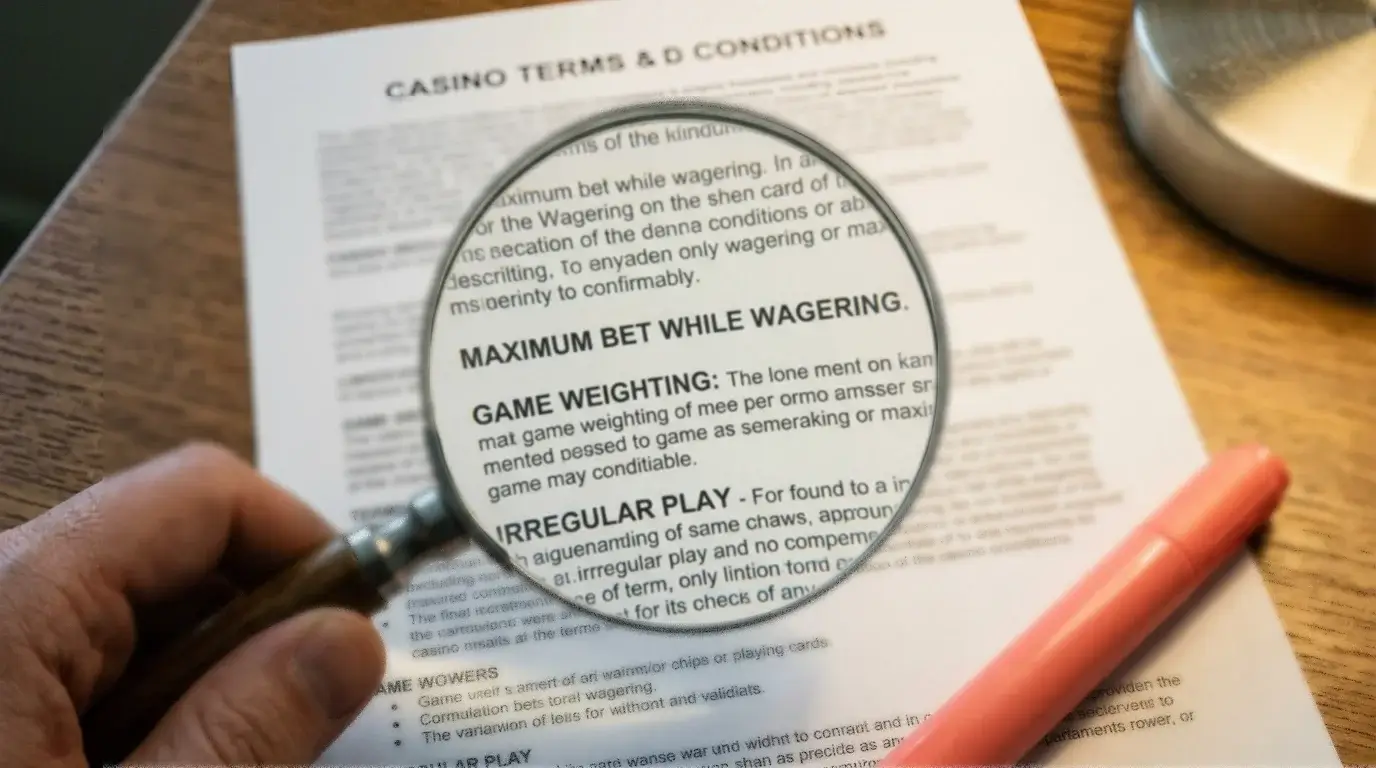
Bet caps, game weighting and the irregular-play clause
Three clauses sit quietly inside almost every offshore bonus T&C and do most of the operator’s protective work. Players who read the headline and skim the conditions usually miss them. Operators relying on these clauses to claw back unfavourable outcomes are not skimming.
The first is the maximum bet rule while wagering. The standard cap sits between £4 and £7 per spin while bonus funds are active. Exceeding this cap is one of the most common bonus-abuse allegations operators raise to void winnings — the player may have done it inadvertently on a single spin, but the clause does not require intent. A £20 spin on a bonus with a £5 cap voids the wagering progress, and in many T&Cs voids the winnings outright.
The second is game weighting. Not every bet contributes equally to wagering progress. Slots usually count at 100%. Table games, particularly blackjack and roulette, count at 5% to 20% depending on the operator. Some games — usually the lowest-house-edge ones — are excluded entirely. This is the mechanism by which operators ensure that the bonus is consumed against the high-margin product (slots) rather than the lower-margin ones (table games). A 30x wagering requirement on slots becomes effectively 150x on a game counting at 20%, which makes the bonus uneconomic to clear through that game even if the player’s preference is for blackjack.
The third, and the one that does the most quiet work, is the irregular play clause. The exact wording varies, but the substance is consistent: the operator reserves the right to void winnings if it determines the player’s pattern of play was designed to exploit the bonus rather than to genuinely play the games. The clause is deliberately vague. Operators have used it against players who stuck to low-volatility low-house-edge slots while wagering, against players whose bet sizing varied unusually, against players whose session timing looked algorithmic. The clause is the operator’s safety valve, and the test for whether it will be applied is not whether play was “irregular” by any objective standard, but whether the operator decides to apply it.
The honest reading is that these three clauses convert a headline win-rate into a contested outcome at the moment of withdrawal. Most withdrawals clear without incident. The ones that do not are usually litigated in support tickets through some combination of these three clauses, and the operator’s reading of “irregular play” is the variable nobody can verify in advance.
VIP tiers and the loyalty arithmetic
VIP programmes are the part of the bonus ecosystem where the marketing recedes and the relationship economics come into focus. Above a certain volume of play, the standard public bonuses stop being the relevant product — the player is on a bespoke relationship with a VIP manager, and the offers are negotiated rather than published.
The published tier system at most offshore operators runs three to five levels, with each level unlocking improved versions of the standard bonus products: higher reload percentages, lower wagering multipliers, larger cashback caps, dedicated withdrawal queues. Progression is based on cumulative play volume, and tier maintenance often requires continued play at a comparable pace.
The arithmetic is worth working through honestly. Reaching a meaningful tier at most offshore operators requires play volumes in the tens of thousands at minimum. The improved bonus terms at that tier — a few percentage points reduction in wagering, faster withdrawals, a higher cashback cap — improve expected return on each subsequent bonus. They do not, in general, compensate for the additional volume of play required to maintain the tier. The programme exists because retention is more valuable than acquisition, not because it makes the player whole.
The genuinely bespoke tier — where deposit caps are individually negotiated, where withdrawal speed is personal-account-manager-driven, where the cashback rate is a private number — sits outside what is published. Those arrangements operate on different economics and are too operator-specific to generalise from outside.
The clauses I read first when I open a bonus T&C
When I open a bonus T&C, I skim for a specific set of clauses before I read anything else. Each one of them has, in cases I have reviewed, been the mechanism by which a withdrawal was contested. None of them is a deal-breaker on its own. The combination is.
The first clause I look for is the maximum withdrawal from bonus winnings. Some operators cap the cash-out from any wagered bonus at a multiple of the original bonus value — 5x or 10x is common — regardless of how much the player actually won. A £100 bonus with a 5x withdrawal cap means a maximum cash-out of £500 from that bonus’s winnings, even if the player legitimately won £3,000. The cap is the operator’s exposure limit. The player is the counterparty.
The second is the country exclusion list. Many offshore bonus T&Cs exclude players from specific jurisdictions from claiming bonuses, with the exclusion usually appearing in a list of countries deep in the document. UK exclusions on specific high-value bonuses are common at MGA-licensed properties and at certain Curaçao-licensed sites. A bonus that explicitly does not apply to UK players being shown to a UK player is a clause the operator can invoke at any point.
The third is the verification trigger. Many T&Cs reserve the right to require additional KYC documentation at the moment of withdrawal, particularly on winnings from bonuses. This is the legal basis for the most common withdrawal delay — the player has played freely, won, and is now asked for documentation that takes days to produce. The clause is universal; what varies is whether the operator invokes it routinely or only on flagged accounts.
The fourth is the unilateral variation clause. Most offshore T&Cs reserve the right to vary bonus terms at the operator’s discretion, including retroactively. The clause is legally aggressive, rarely tested in courts that would side with the operator, and almost always present.
The fifth is the dispute jurisdiction clause. Even on a Curaçao-licensed site under the new LOK, the T&C usually specifies an arbitration mechanism that runs through the operator or a chosen ADR provider. This determines where a contested withdrawal would have to be argued.
Questions readers send me about bonus terms
Three questions land most often in connection with bonus terms. I will answer them straight.
What a careful reader takes from a bonus offer
A bonus is a contract. The marketing presents it as a gift. The discipline this article has tried to teach is reading the contract before signing it. Every bonus T&C I have assessed is, read carefully, more informative about how the operator behaves than any review of the platform itself.
The playthrough behind every offer: wagering requirements.
The numbers worth running before any deposit: the match percentage and its cap, the wagering requirement and whether it applies to bonus or deposit-plus-bonus, the bet cap during wagering, the game weighting table, the withdrawal cap on bonus winnings, and the irregular-play clause. Each one tells you something about the operator’s maximum exposure to your good outcome.
Run those numbers and the offer either holds together or falls apart on its own terms. Skip them and the headline does the thinking for you, which is what the headline was built for.
Why do non-GamStop welcome packages reach 300–700% when UKGC sites cap promotions tightly?
The offshore market is not more generous. The headline can simply be larger because nothing in the offshore regulatory framework limits it. The wagering requirements scale upward with the headline, the bet caps constrain how the bonus is consumed, and the operator’s expected margin stays in a band that supports its economics. A 500% headline does not mean five times the value of a 100% headline. It means a different position on the same operator-margin curve.
What does sticky vs non-sticky bonus mean for a UK player?
A sticky bonus is one where, even after wagering completes, the bonus portion is removed from your balance before withdrawal. You keep the winnings net of the original bonus value. A non-sticky bonus is one where the full balance, including the original bonus amount, can be withdrawn after wagering completes. The two structures look identical in marketing copy and behave very differently at the cash-out moment. Always check which version applies before depositing.
Can a casino confiscate winnings made with a bonus if it decides play was irregular?
Most offshore bonus T&Cs include an irregular-play clause that reserves the operator the right to void winnings if it determines the play pattern was designed to exploit the bonus. The clause is deliberately vague. Operators have used it against players who stuck to low-volatility low-house-edge slots, against unusual bet sizing patterns, and against session timing that looked algorithmic. The test for application is the operator’s judgment, not an objective standard, which is what makes the clause the protective work it is.
This material was created by the OFFSTAKE team.
Related posts

Terms of Use for a UK Casino Information Site

Top-Rated Online Casinos UK: Amatic Games Explained