
Non-GamStop Casinos in the UK: A 2026 Research Explainer
 Available in GB
UK · iGAMING · OFFSHORE

Nine years ago, when I first started tracking the UK gambling market for a niche compliance newsletter, the phrase "non-GamStop casinos" barely showed up in search data. Today it drives some of the loudest pockets of demand in British iGaming — and it sits at the centre of a regulatory argument nobody seems willing to close.
I write this as an analyst, not a promoter. There is no operator I am about to recommend, no welcome offer I am going to flag, no signup link further down the page. What I will do is walk through what non-GamStop casinos UK players actually use look like in 2026, who runs them, how they treat your money, where the law sits, and what happens to a self-excluded gambler when GamStop cannot reach the site they have just opened in another browser tab.
The numbers tell most of the story before I do. The illegal and offshore slice of the UK gambling market climbed from roughly five billion pounds in stakes to more than sixteen and a half billion in 2025. Self-exclusion through GamStop crossed 562,000 active users by year end. Remote Gaming Duty — the tax UKGC-licensed operators pay on online casino revenue — is about to jump from 21 per cent to 40 per cent. Three numbers, one feedback loop. The rest of this article is what sits inside that loop.
£16.6 billion
UK black market and offshore stakes in 2025, up from around £5 billion in 2019.
562,000
Active GamStop self-exclusions by the end of 2025.
40%
New Remote Gaming Duty rate on UKGC-licensed online casino revenue from April 2026.
What to know before reading further
- Non-GamStop casinos are offshore-licensed sites that are not plugged into the UK's national self-exclusion register, so the GamStop block does not stop a UK player from opening an account.
- The illegal and offshore segment of UK staking sits near £16.6 billion in 2025 and is forecast above £33 billion by 2028 — close to one pound in five of all online stakes.
- Curaçao's LOK regime and Anjouan's licence dominate the offshore casino map, and Anjouan in particular formally excludes UK players from its remit even when operators accept them.
- If GamStop is part of your safety plan, an offshore site cannot enforce it — the protections worth knowing about are software blockers, bank gambling blocks, NHS clinics and GamCare's 0808 8020 133 helpline.
What a non-GamStop casino actually is
The first thing I have to do at industry briefings is correct a definition. "Non-GamStop" is not a licensing category. It is not a regulatory status. It is a description of what an operator is missing from its compliance stack.
GamStop is a national multi-operator self-exclusion register run by a not-for-profit company. Every casino, bingo brand or sportsbook holding a UKGC remote licence is required by condition 3.5.5 of the LCCP to integrate with it. When you self-exclude, the register checks your identity against every UKGC-licensed brand and refuses registration. The mechanism only works at sites obliged to look you up.
A non-GamStop casino is therefore an online casino whose operating company holds a gambling licence from somewhere other than the UKGC — Curaçao, Anjouan, Malta, Gibraltar, Kahnawake, Costa Rica — and which has no obligation to query the GamStop database. It accepts UK customers as a commercial decision, not a regulatory one. The technology is the same, the games come from the same studios, the payment rails frequently overlap. What changes is who oversees the operator, who you can complain to, and which UK consumer protections apply when something goes wrong.
GamStop — the national online self-exclusion scheme for Great Britain. Integrating with it is a UKGC licence condition. It does not bind operators licensed only outside the UK.
UKGC channelisation — the share of British gambling spend that flows through licensed, regulated channels. In 2019 it was 97 per cent. By 2025 it had slipped to 92 per cent, and that erosion is the engine behind everything else in this article.
Some sites market themselves as "casinos not on GamStop", "casinos outside UKGC" or "offshore casinos UK". In practice the labels mean the same thing. None of them tells you which licence the operator actually holds, which is the only detail that matters when something goes wrong.
One related misconception is worth flagging. Plenty of UK players assume that because the operator is offshore, the games are somehow different — rigged, looser, cheaper. They are not. The same Pragmatic Play, Hacksaw Gaming, Nolimit City and Evolution titles run at offshore casinos with identical mathematical models. What changes is the environment around the game: the limits, the bonus structure, the dispute pathway.

Where the law actually lands for UK players
The single most common question I get from readers is some version of "am I breaking the law by playing here?" The honest answer is uncomfortable, because the law is built around the operator, not the punter.
Under the Gambling Act 2005, it is an offence to provide facilities for remote gambling to UK customers without a UKGC licence. The operator commits that offence, not you. There is no provision in the Act that makes it illegal for a British adult to place a bet at an offshore casino, and successive Commission statements have made that clear. The enforcement weight falls on the operator: cease-and-desist notices, removal requests sent to search engines, demands made of payment processors, action against affiliates promoting unlicensed sites.
That capacity has expanded faster than most people realise. Since the start of the 2024/25 financial year the UKGC has issued more than 770 cease-and-desist notices, asked Google to remove over 102,000 URLs (around 64,000 were taken down), and got 264 sites removed from their domains entirely — a tenfold jump on the previous year. Andrew Rhodes, the Commission's chief executive, framed it bluntly in his November 2025 statement: "Illegal online gambling remains a serious threat to consumers and to the integrity of the regulated market. While measuring the full scale of the problem is complex, our understanding is growing — and so too is our ability to disrupt illegal operators."
The asymmetry is the part worth holding in your head. A British player is not committing a criminal offence by signing up offshore. But every UK consumer protection wrapped around a UKGC licence — affordability oversight, the £5 stake cap, the credit card ban, the ADR scheme, the deposit limit framework, the GamStop integration — falls away the second you cross that line. You keep the money. You lose the safety net.
One more piece of the legal puzzle keeps coming up in my inbox: tax. UK gambling winnings are not taxable for the punter, because the tax sits on the operator's gross gambling yield. That principle does not flip when you play offshore. HMRC does not chase the player for income tax on a Bitcoin withdrawal from a Curaçao-licensed casino. What HMRC may take an interest in is the source of large unexplained deposits in a UK current account, but that is anti-money-laundering territory.
What pushes British players over the regulated fence
I keep a folder of forum threads, Reddit posts and operator complaint emails going back to 2018, and the tone in 2025 was different from any year I had seen. The complaints used to be about specific brands. Now they are about the UK system itself. The phrase that kept appearing was "they treat us like children." Underneath that emotional driver sits a quieter, structural one: every regulatory tightening in Great Britain pushes a slice of demand somewhere it cannot be measured.
Two regulatory dates from 2025 explain most of the shift. From 9 April, online slots became subject to a £5 maximum stake per game cycle for adults aged 25 and over. From 21 May, the cap dropped to £2 for 18 to 24 year olds. From February, the threshold at which a UKGC operator must run a financial risk assessment — a behind-the-scenes affordability check using credit reference data — fell from a net deposit of £500 in a rolling 30-day window to just £150. Those two changes alone reshaped how a sizeable group of British players felt about their accounts. £150 is, for a lot of people, a Saturday night.
£5 / £2
Maximum slot stake per game cycle: £5 for 25+, £2 for 18 to 24, in force from 2025.
£150
30-day net deposit trigger for a UKGC financial risk assessment, down from £500.
40%
New Remote Gaming Duty from April 2026, up from 21 per cent — a charge offshore operators do not pay.
The third date is still ahead of us. From 1 April 2026, Remote Gaming Duty rises from 21 per cent to 40 per cent, and remote betting duty climbs to 25 per cent a year later. UKGC-licensed operators have not hidden how they feel. John O'Reilly of Rank Group called the increase "a very significant blow to the regulated betting and gaming industry in the UK." Entain warned the change risks pushing regulated operators into "a less attractive and lower quality customer offering compared to the unlicensed and untaxed black market." The maths is real: a 40 per cent tax line forces every UKGC operator to thin the bonus, tighten the loyalty programme, slow the payout queue. Offshore casinos, who pay no UK duty, do not have to make those compromises.
Add the credit card ban from April 2020, the more visible identity friction at sign-up, the strict bonus capping under the Codes of Practice, and you have the migration pattern BGC and Yield Sec have been raising flags about for two years. Yield Sec's Ismail Vali called it bluntly in a January 2026 statement: "Illegal online gambling in Great Britain is now knocking on the door of 10 per cent market share, and it has achieved this through the cynical exploitation of two vulnerable audiences: children and self-excluded gamblers on the GAMSTOP scheme."

The five jurisdictions you will keep meeting
Every few months a reader sends me a screenshot of an unfamiliar logo at the bottom of a casino site and asks, "is this real?" Most of the time it is. The offshore licensing world is smaller than people imagine, and you only need to recognise five names to read 95 per cent of footers in this niche.
The single biggest change in offshore licensing during my career happened on 17 December 2024, when the Curaçao parliament passed the National Ordinance on Games of Chance — universally shortened to LOK — by a 13 to 6 vote. The ordinance took effect on 24 December. From that moment, the old NOOGH master licensor system, where four private "master licence holders" issued sub-licences to thousands of brands, was on a death timer. The deadline for existing sub-licences to migrate to a direct licence from the Curaçao Gaming Authority expired on 24 June 2025. Every Curaçao-licensed brand today either holds a direct CGA licence or is running on borrowed time.
| Jurisdiction | Issuing body | UK policy | Typical use case |
|---|---|---|---|
| Curaçao | Curaçao Gaming Authority (CGA) under LOK | Not restricted from accepting UK players; operator's commercial decision | The dominant licence for offshore casinos serving UK and global markets |
| Anjouan | Anjouan Offshore Finance Authority | UK formally listed as a restricted territory in the licence terms | Low-cost B2C licence — €17,828 a year — used by newer brands |
| Malta | Malta Gaming Authority (MGA) | EU passporting; UK customers accepted by some operators since Brexit | Premium EU positioning; tighter compliance and player funds rules |
| Gibraltar | Gibraltar Gambling Commissioner | Long association with UK operators; many dual-licensed with UKGC | Operators with strong British heritage and corporate footprint |
| Kahnawake | Kahnawake Gaming Commission (Canada) | No specific UK restriction; smaller footprint in modern UK-facing market | Legacy operators and some sportsbook brands |
Two details from that table deserve emphasis. Anjouan's licence costs around €17,828 a year for B2C operators, with a parallel B2B regime introduced from July 2025. That low entry point is why Anjouan grew so quickly. But Anjouan's own licence terms explicitly bar operators from offering services to customers in the United Kingdom, United States, France, Germany, Netherlands, Spain, Australia and Austria. When you see an Anjouan-licensed brand accepting UK players, that operator is, by the strict reading of its own licence, out of scope. It is a regulatory grey zone the brand has chosen to inhabit.
For the full technical breakdown of how each licence works, the legitimacy criteria I personally apply, and how to verify a CGA seal against the regulator's register, I have written a dedicated piece — see my deep dive into non-GamStop casino licensing.
How the money actually gets in and out
The fastest way to tell a UKGC casino from an offshore one is to look at the deposit screen. Pull up a regulated British site and you will see Visa and Mastercard debit, Trustly, PayPal, sometimes Apple Pay. Pull up a Curaçao-licensed site and the list extends — credit cards, USDT on three chains, Bitcoin, Litecoin, Revolut, Skrill, Neteller, voucher methods.
The reason is regulatory, not technological. From 14 April 2020 the UKGC banned the use of credit cards for online gambling. That ban does not exist offshore. Crypto deposits operate in a similar gap: UK banks discourage them through their own gambling-block features, but no UK rule forbids the operator from accepting them. Revolut sits in a hybrid space — the fintech has implemented gambling block features for UK customers, but enforcement varies by merchant category code.
| Payment method | Typical UKGC site | Typical non-GamStop site |
|---|---|---|
| Debit card | Standard | Standard; may route through alternative acquirers |
| Credit card | Banned since April 2020 | Frequently accepted |
| E-wallets (Skrill, Neteller) | Less common; some operators dropped them | Standard |
| Cryptocurrency (BTC, ETH, USDT) | Not accepted | Common, often the preferred withdrawal rail |
| Apple Pay / Google Pay | Standard, tied to UK debit cards | Inconsistent; depends on acquirer relationships |
| Revolut card | Subject to Revolut's own gambling block | Subject to Revolut's own gambling block |
What changes most when you cross offshore is the withdrawal experience. UKGC operators run their KYC checks largely at sign-up, so first withdrawals are usually quick. Offshore operators frequently defer full identity verification until you ask for your first payout, which is when complaints cluster — a topic I will return to in the dispute resolution section. Crypto withdrawals at a properly licensed offshore site can land in under an hour. Wire transfers can take five working days. Cards, when available, are somewhere in between.
I will not pretend the payments landscape is settled. It moves quickly, and each method has its own quirks once you scratch the surface. For operational detail — banking codes, chargeback realism, instant withdrawal terminology, what Revolut blocks and what slips through — see my guide to payment methods at non-GamStop casinos.

Why the welcome packages look so loud
If you have ever wondered why a non-GamStop casino advertises a "300 per cent welcome package up to £3,000" when a UKGC site offers a £50 match with strings attached, you are looking at the visible edge of the channelisation problem. The bonus is not generosity. It is acquisition cost.
UKGC operators work under strict rules: bonus terms must be clear and prominent, wagering requirements cannot be hidden in the small print, multi-tier welcome packages are constrained, and the new affordability framework has clipped the kind of high-stakes redepositing big bonuses were built to encourage. Offshore operators have no equivalent regulator. Yield Sec's analysis found that 84 per cent of all illegal gambling advertising in the UK is built around the search intent "not on GamStop". Operators in that space know the player has already chosen to look there. The bonus is what gets them across the registration form.
The largest welcome offers I see now reach 700 per cent across a five-deposit package. Strip out the marketing and they are typically 40 to 45 times wagering on the deposit plus bonus, with maximum-bet rules of around £5 per spin and a restricted-games list that excludes anything mathematically interesting. The headline number is the part designed for the search snippet, not the part you actually transact against.
The mechanics worth understanding here are simple. A "sticky" bonus is bonus money removed from your balance when you withdraw real funds — you only ever cash out winnings beyond the wagering bar. A "non-sticky" bonus sits separately: you can withdraw your own deposit at any point, but you lose the bonus when you do. Wagering requirements apply either to the bonus alone or to "deposit plus bonus" — the latter roughly twice as hard to clear. Game weighting tables decide what counts: slots usually 100 per cent, table games 10 per cent or less, live dealer often zero.
None of this is unique to offshore casinos. The same vocabulary appears on regulated sites. What changes is the size of the headline, the looseness of the small print, and the existence of so-called "irregular play" clauses that let an operator void winnings if your betting pattern looks too clever. The full anatomy — sticky versus non-sticky, max-bet rules, game weighting, cashback gross versus net — is the territory of my deep look at non-GamStop bonuses.

What protection survives the move offshore and what does not
The most uncomfortable conversation I have in this niche always starts the same way: a player has a dispute, the operator has gone quiet, and the player wants to know who is going to step in. Nobody equivalent to the UKGC's regime is going to step in. The shape of dispute resolution offshore is fundamentally different, and the gap is where most of the harm in this space lives.
A UKGC-licensed operator has to belong to an approved Alternative Dispute Resolution scheme — usually IBAS or eCOGRA. If a complaint cannot be resolved internally, the ADR is free to the player, the decision is binding on the operator, and the Commission can act against a brand that ignores it. None of that structure exists at most offshore licences. The Curaçao Gaming Authority under LOK has built a complaints process and is staffing it up. Anjouan and Kahnawake have player-protection rhetoric that in practice comes down to forwarding emails. An offshore complaint either resolves at the operator's discretion or it goes to a community arbiter — a forum thread, AskGamblers — none of which has enforcement power.
Andrew Rhodes, in his October 2025 IAGR keynote, said something I have been quoting ever since: "There is nothing more exploitative than the illegal market." The phrasing matters. Not less protective, not more risky — exploitative. The asymmetry of information between offshore operator and individual player is, in the Commission's view, the defining harm of the segment.
Yield Sec's Ismail Vali made the second half of that argument in a September 2025 interview: "If you set up a scheme like GamStop and you tell vulnerable customers they are safe, surely you should make them safe." From the player's perspective, the practical risks cluster around four headings: delayed or refused withdrawals, KYC weaponisation (documents demanded only after a win), bonus-abuse allegations used to void winnings, and cloned sites trading on legitimate operator names.
Do
- Read the dispute resolution clause before depositing; find the named arbiter, if any.
- Complete identity verification before your first deposit, even when not asked.
- Keep screenshots of every bonus opt-in and every support chat conversation.
- Use a payment method you can track separately from your day-to-day banking.
Avoid
- Sites where ownership and licensing details hide behind a generic footer logo.
- Operators marketing "no KYC" — every legitimate licensee has KYC obligations.
- Bonus claims you do not intend to clear; sticky terms are designed to wear you down.
- Treating community arbiters as a guarantee — they are persuasion, not enforcement.
I have laid out the realistic dispute scenarios, the chargeback question, KYC timing and the red-flag patterns in much more detail in my analysis of non-GamStop casino safety. The summary above is the version every UK player should know exists before crossing the line.

The GamStop ecosystem in numbers
I cannot write about non-GamStop casinos without sitting properly with what GamStop itself has become. The scheme started in April 2018 as a small voluntary register and has, by the end of 2025, grown into one of the most extensive multi-operator self-exclusion systems in the world. It is the lens through which most of the offshore migration story should be read.
Active registrations crossed 562,000 by the end of 2025, with cumulative registrations approaching 600,000 across the scheme's lifetime. The trajectory steepened during the year: April 2025 was the first month in history to record more than ten thousand new sign-ups (10,281 of them), May beat it with 10,344, and the second half added another 58,675 registrations at an average of 319 a day. Among 16 to 24 year olds, year-on-year growth in new registrations was 40 per cent in the second half.
562,000
Active GamStop self-exclusions at the end of 2025; cumulative registrations near 600,000.
+40%
Year-on-year growth in new GamStop sign-ups among 16 to 24 year olds in H2 2025.
47%
Share of 2025 registrants who chose the maximum five-year self-exclusion. In December, more than half of those opted for auto-renewal.
The pattern inside those numbers tells a story. The December auto-renewal share effectively converts the five-year block into an indefinite one. Younger users behaved differently: 38 per cent of 16 to 24 year olds chose the shortest six-month duration, suggesting a circuit breaker rather than a permanent measure.
"Our data shows a significant spike in the number of younger consumers who are Gamstopping to manage their gambling, and this has driven the record registrations in 2025." — Fiona Palmer, CEO, Gamstop.
Palmer has been candid about the other half of the picture. In a July 2025 interview she described affiliate sites that promote non-GamStop casinos as "absolutely abhorrent." That hostility comes from the fact that a self-excluded user who breaks down and searches for an offshore site is exactly the consumer the protection was built for. For the offshore industry, the same data reads differently: a growing pool of self-excluded players becomes a demand signal nobody else is supplying. Yield Sec's finding that 84 per cent of illegal gambling advertising is built on "not on GamStop" intent is the marketing layer sitting on top of that registration trend.
Building your own safety net when GamStop does not reach
This is the section I have to be most careful with, because the people most likely to read it are the people I am most worried about. If you are using non-GamStop casinos as a workaround after a self-exclusion you put in place yourself, please do not skip the rest of this page. The point is not to lecture — it is to walk through what still works when GamStop does not.
The first thing to know is the size of the supportive infrastructure in the UK. Health Survey for England 2024 figures place around 5 per cent of adults in the at-risk or problem-gambling categories, with less than 1 per cent meeting the problem-gambling threshold. The Gambling Treatment Needs Assessment published in August 2025 suggested roughly 1.6 million adults in England gamble in ways that could benefit from support. Between April and September 2024, NHS specialist clinics treated 1,914 patients — a 130 per cent year-on-year increase — and by December there were 15 dedicated NHS gambling clinics in England.
The statutory levy on UK-licensed gambling operators came into effect in April 2025, raising approximately £100 million a year. Half of that goes to NHS England for treatment, 30 per cent to the Office for Health Improvement and Disparities for prevention, and 20 per cent to UKRI and the Commission for research. The infrastructure paid for by that levy applies regardless of whether you have been playing at a UKGC site or an offshore one.
If GamStop is no longer enough, the protections worth knowing about are layered. Software blockers like Gamban and BetBlocker run on phones and computers and block thousands of gambling URLs at the device level, including non-GamStop sites. They cost a small monthly fee or, in BetBlocker's case, nothing, and survive even if you reinstall your browsers. Bank-level gambling blocks from most UK high street banks, Monzo, Starling and (with caveats) Revolut refuse merchant category code 7995 transactions outright. The combination is harder to defeat than either layer alone.
Operator-side limits also still work, even at an offshore site. Deposit, loss, session limits and reality checks are not UKGC inventions — they exist in some form at almost every licensed Curaçao operator under LOK and are mandatory inputs into the responsible-gambling section of any compliant operator's terms. You will not get UKGC-grade enforcement, but you can still set them.
For anyone reading this in any kind of difficulty: GamCare's National Gambling Helpline runs 24 hours a day on 0808 8020 133, the NHS National Gambling Treatment Service accepts self-referral, Gordon Moody offers residential treatment, and Gamblers Anonymous holds meetings across the country. None of these are conditional on which licence the operator that took your money held.
The deeper toolkit — software blockers compared, bank blocks compared, operator-side limits explained, NHS clinic referral pathways, residential support eligibility — sits in my framework for responsible gambling when GamStop is not an option.

The actual demographic walking through the offshore door
Whenever a journalist asks me to sketch the typical non-GamStop player, I push back. There is no single profile. There are four distinct ones, and conflating them is how this whole policy debate keeps getting muddled.
The first group is the spillover from regulatory friction: British adults who have not self-excluded, who do not have a gambling problem in any clinical sense, but who have hit the new £150 financial-risk-assessment threshold or the £5 stake cap and resented being slowed down. They are the cohort operators most want to court — commercially valuable, operationally simple.
The second group is the demographic with the highest growth rate in self-exclusion: under-25s. Among 16 to 24 year olds, GamStop registrations grew 44 per cent year-on-year in the first half of 2025, with 38 per cent choosing the shortest six-month duration. Those who pick the short option as a pause are the ones most exposed when search engines surface offshore alternatives during the block period.
The number behind almost every policy debate this year is 562,000 — the active GamStop register. That is not the population at risk; the population at risk is much larger. It is the population that has actively asked for a block. The non-GamStop industry is, in operator terms, partly addressing demand from people who have raised their hand and asked the regulated market not to serve them. The ethical weight of that fact is the single hardest thing to discuss in this niche.
The third group is the crypto-first segment that never had a strong relationship with UKGC sites. They came in through Bitcoin, USDT and Ethereum, do not particularly want a credit card in their gambling history, and treat offshore as their default. Small in absolute numbers but disproportionately visible on forums and social media.
The fourth group is the high-stakes player pushed offshore by the affordability regime. UKGC requirements at the higher end — source-of-funds documentation, hard deposit caps — have made the regulated market harder to use at scale. A meaningful slice of high-net-worth British players now plays primarily through offshore-licensed brands.

UKGC and offshore, line by line
It is easy to talk about offshore and UKGC sites in abstractions. The differences are clearer when you put them next to each other line by line.
| Feature | UKGC-licensed site | Non-GamStop site |
|---|---|---|
| Self-exclusion | Mandatory GamStop integration | None; operator-side limits only |
| Slot stake cap | £5 per game cycle (£2 for 18 to 24) | Operator discretion; typically uncapped or capped at much higher levels |
| Affordability checks | Light financial risk assessment from £150 net deposit in 30 days | None at the regulatory level; AML thresholds apply |
| Credit cards | Banned since April 2020 | Frequently accepted |
| Bonus capping rules | Strict; clear and prominent terms required | Operator discretion; headline percentages much higher |
| Game-cycle minimum spin time | 2.5 seconds, no autoplay, no quick-spin | Operator discretion; turbo and autoplay common |
| Dispute resolution | Approved ADR scheme (IBAS, eCOGRA) | Operator-level; community arbiters non-binding |
| Tax on winnings | No personal tax — taxed on operator | No personal UK tax — taxed offshore where applicable |
| Remote Gaming Duty paid by operator | 40% from April 2026 | 0% to UK Treasury |
Two of those lines deserve a closing word. The 2.5 second minimum game-cycle on slots is a UKGC rule from the 2021 Remote Technical Standards review, designed to slow the rate of loss. Offshore operators are under no such constraint, which is why a Pragmatic Play slot at a Curaçao-licensed site spins noticeably faster than the same title on a UKGC casino — same maths, different velocity. That difference is probably the single most underrated harm vector in the offshore segment.
The other line is the tax one. Offshore operators contribute nothing to the UK Treasury, nothing to the statutory levy that funds NHS treatment, nothing to the research and prevention budget that levy supports. Grainne Hurst of the BGC put it sharply in a May 2026 statement: "These forecasts are a wake-up call. The black market is not a distant threat; it is growing fast, becoming more visible, and attracting billions of pounds in stakes from British customers. By 2028, almost one in five pounds staked online could be with illegal operators." The forecast she was reacting to was the H2 Gambling Capital projection of black-market stakes above £33 billion by 2028, against a 2025 figure of £16.6 billion.

OFFSTAKE · proprietary model
The Velocity Ledger
The same slot, the same RTP, two different speeds. This models what the UKGC's 2.5-second game cycle and £5 stake cap are actually worth in pounds per hour — and what happens in a lane where neither rule applies.
UKGC-licensed lane
Offshore lane
The offshore lane reaches the regulated lane's full-session expected loss in 29 min.
Expected loss is turnover multiplied by house edge (100% − RTP). It is a long-run average, not a prediction: any single session swings far above or below it. The model assumes continuous play at the selected pace and identical game maths in both lanes, which is the point — the underlying slot is the same title from the same studio. Regulated-lane parameters follow the UKGC Remote Technical Standards (2.5s minimum game cycle, no autoplay or quick-spin) and the 2025 stake caps of £5 for players aged 25 and over, £2 for 18 to 24 year olds.
If the numbers above feel familiar rather than theoretical, help is free and confidential: GamCare's National Gambling Helpline is open 24 hours a day on 0808 8020 133, and the NHS National Gambling Treatment Service accepts self-referral. Device-level blockers and bank gambling blocks work regardless of which licence an operator holds.
How Britain compares to the rest of Europe
If you only follow British coverage, the offshore migration looks like a uniquely UK problem. Look across the channel and the story rearranges itself. The UK's slip from 97 per cent channelisation in 2019 to 92 per cent in 2025 is, in European terms, still relatively healthy. The countries that lead with restrictive regimes and high duties have far worse exposure.
PwC's 2025 modelling for European betting and gaming markets put the offshore share in France at 57 per cent, in the Netherlands at 37 per cent, and in Sweden at 35 per cent. Spain and Denmark, which combine moderate tax with a more measured set of player-protection rules, hold their offshore exposure at around 11 per cent. The throughline is consistent: restriction without proportionality drives channelisation down.
57%
Estimated offshore share of the French online gambling market — the worst-case scenario in Europe under PwC's 2025 model.
$5.1 trillion
Stakes placed at illegal gambling sites globally in 2023, on Yield Sec's estimate — a figure comparable to the third-largest national economy.
The global picture, on Yield Sec's count, is staggering. In 2023, around $5.1 trillion was staked across illegal gambling sites worldwide — a sum that would rank the segment behind only the US and Chinese economies if it were a country. Britain's £33 billion forecast for 2028 is a small national contribution to a vast global trade.
The reason this comparative frame matters is that it changes the policy conversation. If you treat the UK offshore problem as a British failure, the answer looks like more enforcement and tighter rules. If you treat it as a European baseline plus regional friction, the answer looks like calibration — keeping the UKGC framework strict enough to protect the vulnerable, soft enough to keep mainstream demand on the regulated side, and aware that every duty rise has a measurable channelisation cost.

The warning signs I look for first
The most useful piece of professional muscle memory I have built up over nine years is the ten-minute scan I run before I take a new offshore operator seriously. It filters out the worst of the segment quickly. The signal is in the things operators leave out, not in what they shout about.
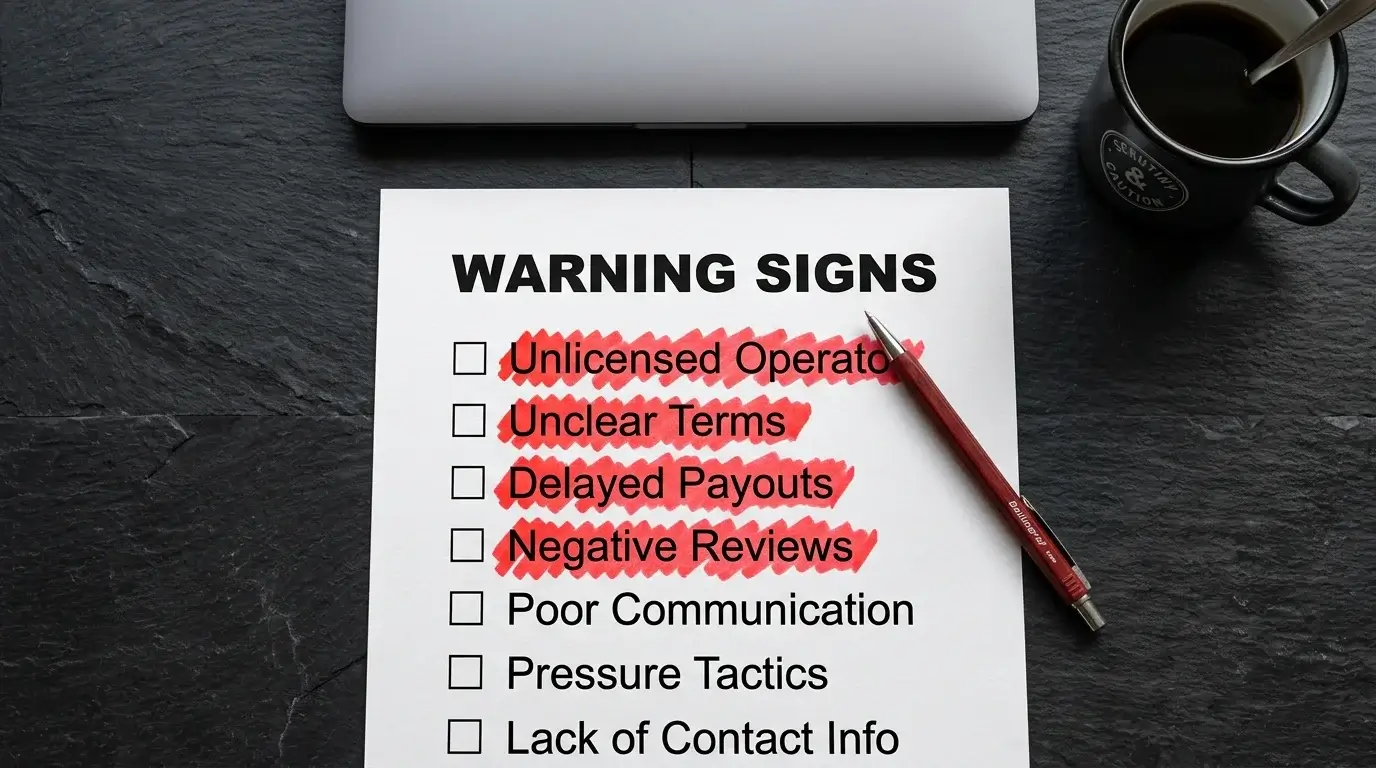
The licensing footer is the first stop. A legitimate Curaçao operator will name its licence number and link directly to the Curaçao Gaming Authority's verification page. A legitimate Anjouan operator will publish its certificate number and reference the Anjouan Offshore Finance Authority. If the footer shows a logo that does not click through to a regulator's register, or if the register entry does not show the operating company name visible on the terms-of-service page, that is the first red flag.
Look for
- A linked licence number that resolves on the regulator's own website with matching operating-company details.
- A dispute resolution clause that names a specific arbiter or process.
- Published terms for KYC: when documents will be requested, and what specifically.
- Clear bonus terms with wagering, max-bet and game-weighting numbers visible without claiming the offer.
- Operator-side responsible-gambling tools that are functional, not decorative.
Walk away from
- Sites where the licensing logo is an image with no link or with a link to a non-regulator domain.
- "No KYC" marketing — no compliant offshore licence permits a truly KYC-free B2C operation in 2026.
- Domain age under 60 days combined with aggressive headline bonuses.
- "Irregular play" clauses granting the operator unilateral, undefined power to void winnings.
- Customer service that lives entirely on a Telegram channel or live chat with no email address.
Cloned domains deserve their own warning. Ismail Vali described the dynamic at a Peers for Gambling Reform event in September 2025: "You go after the people who have no choice, children and self-excludes." Cloned sites copy the branding of a known legitimate operator under a near-identical URL and spike around major sporting events and peak GamStop registration windows. The defence is unglamorous: always navigate through a verified link from the licence register, not through a search result.
The last red flag requires reading the terms of service. Look for the jurisdiction clause that names the law applicable to disputes. If it points to Curaçao, that is consistent with a CGA-licensed operator. If it points to the Comoros (Anjouan's jurisdiction) and you are a UK player, you are dealing with an operator whose licence explicitly does not authorise it to take you on.
Where this leaves you and where to get help
If you have read this far, you already know more about the offshore casino segment than most British players who have ever signed up to one. The point was never to push you towards or away from any operator — it was to lay out the structure so you can make your own decisions with the facts visible.
The two things I will say in closing are easiest to forget once the tab is open. First, the asymmetry of information is the defining feature of this market. Offshore operators know far more about you, your behaviour and your wallet than you will ever know about them. Second, the protections that work when GamStop does not are layered and unglamorous: device-level blockers, bank gambling blocks, operator-side limits, NHS services. Jenny Watson, the outgoing chair of Gamstop, captured the wider point in her April 2025 annual report: "We have made significant progress in our mission to safeguard people from the harms of gambling addiction... Our success is measured not only by the numbers but by the stories of transformation and recovery."
If you or someone you know needs support: the National Gambling Helpline runs 24 hours a day, seven days a week, on 0808 8020 133, free from landlines and mobiles in the UK. The NHS National Gambling Treatment Service accepts self-referral through its website. Gordon Moody provides residential and online treatment for severe gambling harm. Gamblers Anonymous hosts meetings across the country. None of these services are conditional on which operator took your last deposit.
Questions I get asked most often
These are the seven questions that turn up most often in my inbox. The article above was structured around making the long answers unnecessary.
Are non-GamStop casinos legal for UK players in 2026?
Playing at an offshore casino is not a criminal offence for a British adult. The Gambling Act 2005 places the regulatory obligation on the operator. What changes is the consumer protection layer: no UKGC oversight, no GamStop integration, no mandatory ADR scheme. Enforcement targets operators — more than 770 cease-and-desist notices went out in the 2024/25 financial year.
How do non-GamStop casinos differ from UKGC-licensed sites in practical terms?
Three differences carry the weight. Stake caps: UKGC sites cap online slots at £5 per game cycle (£2 for 18 to 24 year olds), offshore sites typically do not. Game speed: UKGC slots run on a 2.5 second minimum spin time; offshore slots run faster. Bonuses: UKGC operators work under strict rules, offshore packages in the 200 to 700 per cent range carry longer wagering trains. Behind those sit affordability checks from £150 and the credit card ban.
Which licences do non-GamStop casinos hold, and what do they mean?
Five names cover most of what you will see. Curaçao is the largest, now under direct CGA licensing after the LOK reform took effect on 24 December 2024 and the old sub-licence regime expired on 24 June 2025. Anjouan is the cheapest entry point at €17,828 per year but formally restricts UK, US, French, German, Dutch, Spanish, Australian and Austrian customers. Malta (MGA) is the EU-grade premium licence. Gibraltar has long historical ties with UK operators. Kahnawake holds a smaller and ageing portfolio.
What are the real risks of playing at non-GamStop casinos?
Four risk categories cluster most often: delayed or refused withdrawals, KYC weaponisation where documents are requested only after a win, bonus-abuse allegations used to void winnings under "irregular play" clauses, and cloned-site fraud trading on legitimate operator names. The structural risk underneath all four is the absence of binding dispute resolution.
What payment methods work at non-GamStop casinos for UK players?
The deposit menu extends beyond UKGC sites in three directions. Credit cards are accepted (UKGC banned them for gambling from 14 April 2020). Cryptocurrency — Bitcoin, Ethereum, USDT across multiple chains — is standard. E-wallets including Skrill and Neteller remain in regular use. Revolut sits in a hybrid space: the fintech's gambling block can intercept transactions but enforcement varies by merchant category code. Withdrawal speed varies wildly by method.
Can I still self-exclude or set limits at a non-GamStop site?
Direct GamStop integration is not available, but layered protections still work. Software blockers (Gamban, BetBlocker) operate at the device level. UK bank gambling blocks at merchant category code 7995 refuse transactions outright at most banks. Operator-side limits exist at most CGA-licensed sites under LOK clauses. NHS specialist clinics accept self-referral and treated 1,914 patients between April and September 2024.
Will I owe UK tax on winnings from an offshore casino?
UK gambling winnings have not been taxable for the player for many years; the tax sits on the operator's gross gambling yield. That principle does not change because the operator is offshore. HMRC does not pursue an income tax charge on a Bitcoin withdrawal from a Curaçao-licensed casino. The caveat: large unexplained deposits into a UK current account can prompt anti-money-laundering scrutiny from the bank, which is separate from gambling taxation.
If you take one thing from this FAQ, take this: every question above is about an absence. An absence of UKGC oversight, an absence of binding dispute resolution, an absence of GamStop coverage, an absence of statutory protection. The features that make non-GamStop casinos commercially attractive are the same features that remove the safety net underneath them.
Related posts

Terms of Use for a UK Casino Information Site

Top-Rated Online Casinos UK: Amatic Games Explained