
Payment Methods at Non-GamStop Casinos: What Actually Works for UK Players
 Available in GB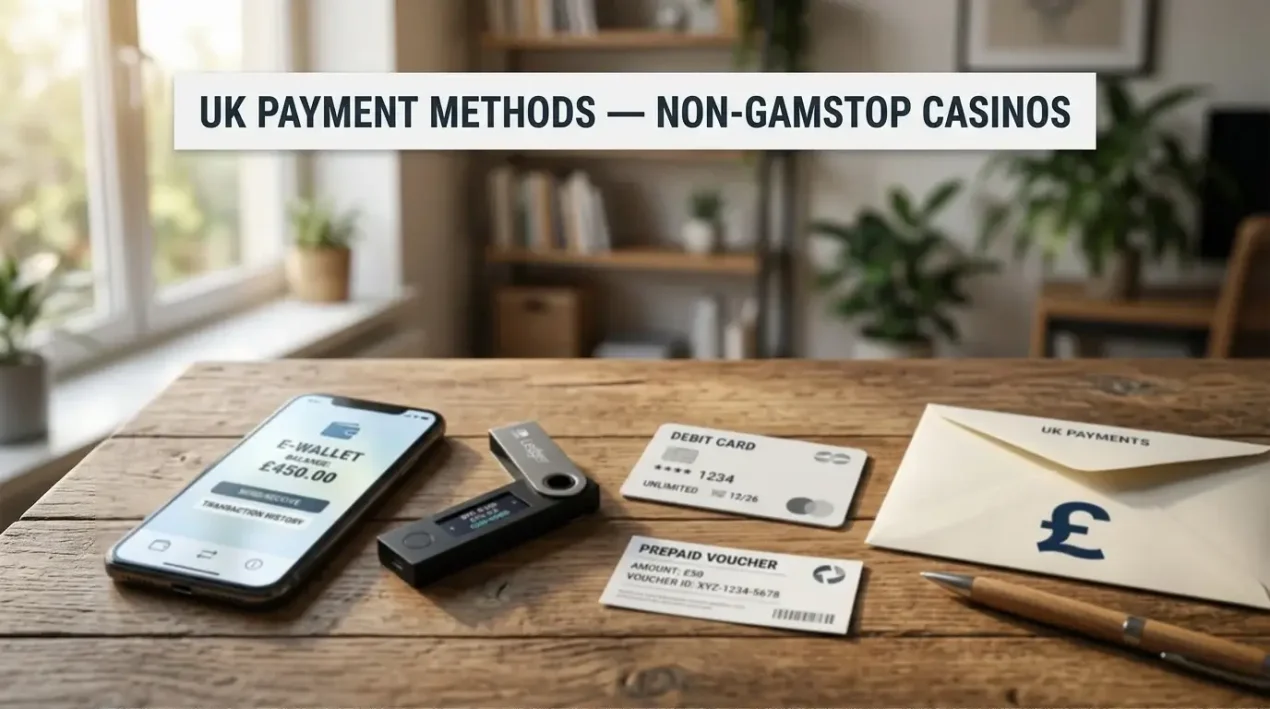
The single most expensive misunderstanding I see in my inbox is this one: a UK player thinks of a casino deposit as a single action — money goes from my account to the casino. It is never a single action. A deposit at a non-GamStop site routes through at least three institutions, sometimes five, and any one of them can decline, freeze, charge a fee, or quietly report the transaction. The casino is only the final stop. Everything before it has its own rules.
Payment infrastructure is the part of the offshore market that has changed the most in the past two years, and most of the change has been forced by the UK side rather than the operator side. UK banks have rebuilt their card-network gambling controls. Open banking has matured. Crypto has become institutionally legitimate enough that operators can plug into it through compliant providers. And the offshore advertising ecosystem around all of this has scaled too — illegal gambling advertising spend in the UK reached around £800 million in 2025, close to half of total gambling ad spend, which tells you how much money is chasing this question.
What I want to give you here is the mechanics. Not which method is “best” — that depends on what you are doing — but how each one moves money in 2026, where it is likely to break, how long withdrawals actually take in practice, and what the hidden costs look like. The aim is to make you a less confused customer of payment rails, regardless of which operator you happen to be using them with.
The full picture is in our explainer on non-GamStop casinos.
The payment landscape after the 2025 UKGC rule changes
A reader asked me last spring why their deposit at an offshore site had started failing in May 2025 when it had worked fine in March. The answer was not the offshore site. The answer was that on 21 May 2025 the UK regulatory perimeter shifted in a way their bank had to comply with.
Two UKGC reforms reshaped the payments landscape in 2025, and both of them push pressure outward toward offshore alternatives in ways the regulator did not necessarily intend. From 9 April 2025, the online slots stake limit for players aged 25 and over was fixed at £5 per game cycle. From 21 May 2025, the same limit dropped to £2 per cycle for the 18-to-24 cohort. The change was framed as a player-protection measure, and from a harm-reduction standpoint there is a real argument for it. From a market-behaviour standpoint, it gave a meaningful slice of higher-stakes UK players a concrete reason to look at venues without that ceiling — which is what they did.
The second reform sits further upstream. The Financial Risk Assessment threshold, which used to trigger affordability checks at £500 of net deposits over 30 days, was lowered to £150 from February 2025. That is the level at which a UKGC-licensed operator must run a frictionless check on a customer’s risk profile, and although 97% of those checks pass without the player even noticing, the threshold itself has become the reference point that pushes some players to look for environments without the equivalent control. None of this is a recommendation. It is a description of the gravity that the reform created.
What this means for payment methods specifically is that the routes most associated with UKGC compliance — card payments processed through merchants that respect UK gambling MCC codes, e-wallets that enforce gambling-specific controls, open banking flows that surface gambling spend categorisation to the bank — are all carrying more enforcement signal than they did two years ago. The offshore market has adapted by leaning harder into the rails that carry the least UK enforcement signal: crypto, certain neobank flows, and prepaid voucher infrastructure.
Our top casino picks for the UK
- x3betBonus: Welcome Pack 100% Up to £1.000 + 200 Free Spins · Payout speed: 1-3 business days
- NightWinBonus: £900 + 400 free spins · Payout speed: 1-3 business days
- Revery PlayBonus: 100% up to€1,000+ 100 FS · Payout speed: 1-3 business days
- DieselwinBonus: Welcome Pack 250% up to £4000 + 200 FS · Payout speed: 1-3 business days
- ChanzeBonus: Slots Welcome Bonus #1 200% up to €500 · Payout speed: 1-3 business days
- BritsinoBonus: Welcome Package – Get your £2,200 + 2,000 FS · Payout speed: 1-3 business days
- SlotoSportBonus: 500% up to £ 10 200+ 777 FS · Payout speed: 1-3 business days
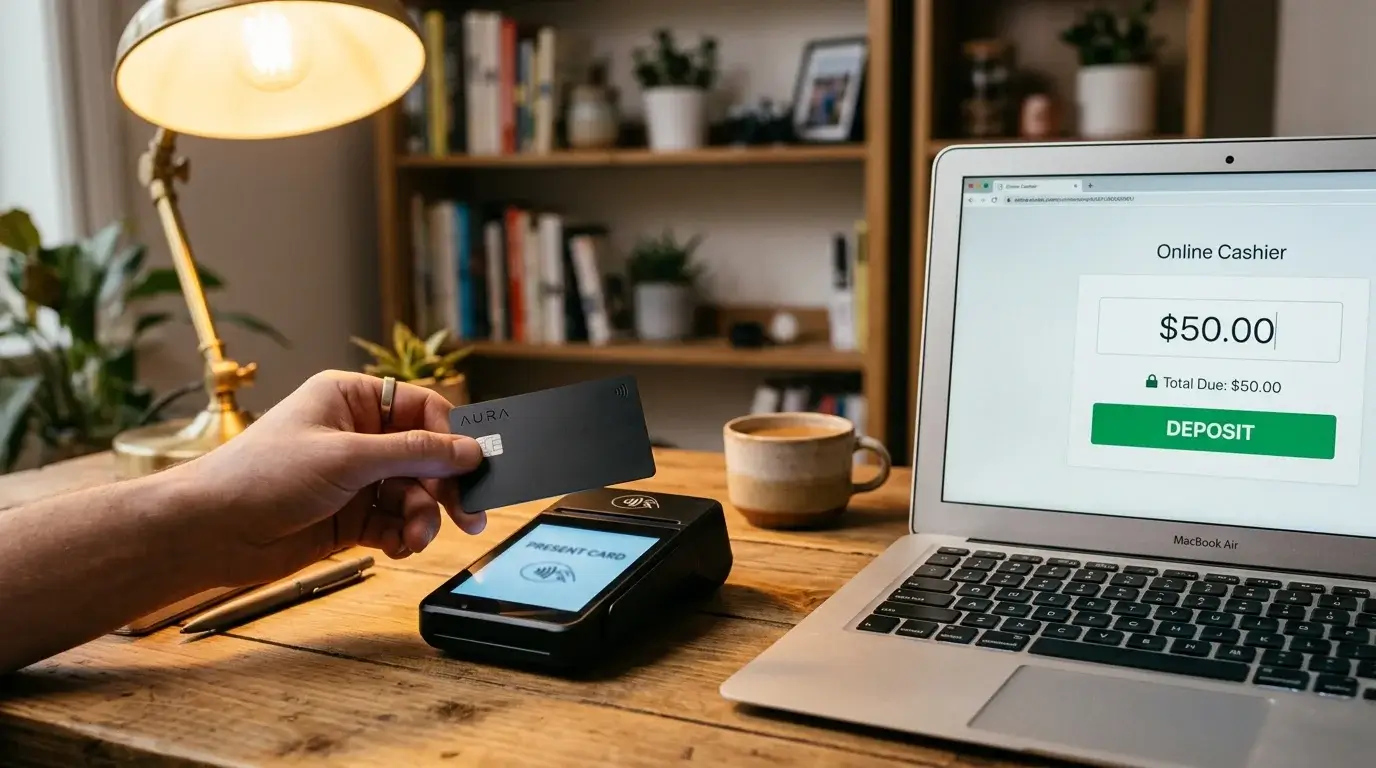
Debit cards and credit cards on the offshore side
I want to start with cards because they are the most familiar instrument and also the one whose behaviour has shifted most dramatically since 2020. A UK player thinks of a debit card as a default. The card network does not.
Credit cards for gambling were banned in the UK in April 2020 by a UKGC direction that applied to all UKGC-licensed operators. The ban does not technically extend to credit-card use at offshore sites — the UKGC cannot impose conditions on operators it does not license — but the card networks themselves, Visa and Mastercard, layer their own merchant category code rules on top. Most UK-issued credit cards now decline at gambling MCCs regardless of the operator’s regulatory home, because the issuer’s own gambling block applies at the MCC level. The card never sees the operator’s licence.
What actually happens when an offshore deposit is attempted with a UK credit card depends on three layers in sequence. First, the acquiring bank — the institution processing the casino’s side — assigns an MCC to the transaction. If the MCC is the gambling code, 7995, the transaction is flagged. Some offshore acquirers deliberately route through alternate MCCs to dodge this — a payment for “merchant services” or “general retail” might be the casino — and that is the practice the UKGC and the FCA have been pushing back against most aggressively. Second, the card network applies its own rules. Third, the issuing UK bank applies its rules, which on credit cards almost universally now means a hard decline at 7995.
Debit cards work more often, but with caveats. Most UK banks now offer a gambling block as a customer-toggleable setting. If the toggle is on, debit-card deposits at gambling MCCs decline at the issuer level. If the toggle is off, the deposit goes through. The transaction is, however, visible to the bank’s transaction monitoring, and although a single small deposit does not raise any flags, repeated higher-value deposits at offshore-coded merchants can prompt the bank to request a conversation about the activity. None of this stops the deposit, but the player who treats card use as anonymous is misunderstanding what their bank can see.
Andrew Rhodes, the UKGC chief executive, has been explicit about the international coordination angle here: respectable regulators around the world all want the same thing — illegal gambling to stop, which is why we are sharing information to help them as well as us. The card-network gambling controls are one of the mechanisms that information-sharing actually runs through, because the MCCs and the acquirer reporting are infrastructure that crosses jurisdictions.
One thing I want to flag because it comes up so often: card payments to offshore casinos are not reported to UK credit reference agencies in the way some people fear. The transaction shows on the bank’s own statement and in the bank’s internal monitoring, but it does not produce a credit-file entry the way a missed loan payment would. Confusing those two is a separate, common misunderstanding.
E-wallets — Skrill, Neteller, MuchBetter and the rest
E-wallets used to be the cleanest answer to “how do I move money to an offshore casino?” That has stopped being true in a way most online write-ups have not caught up to.
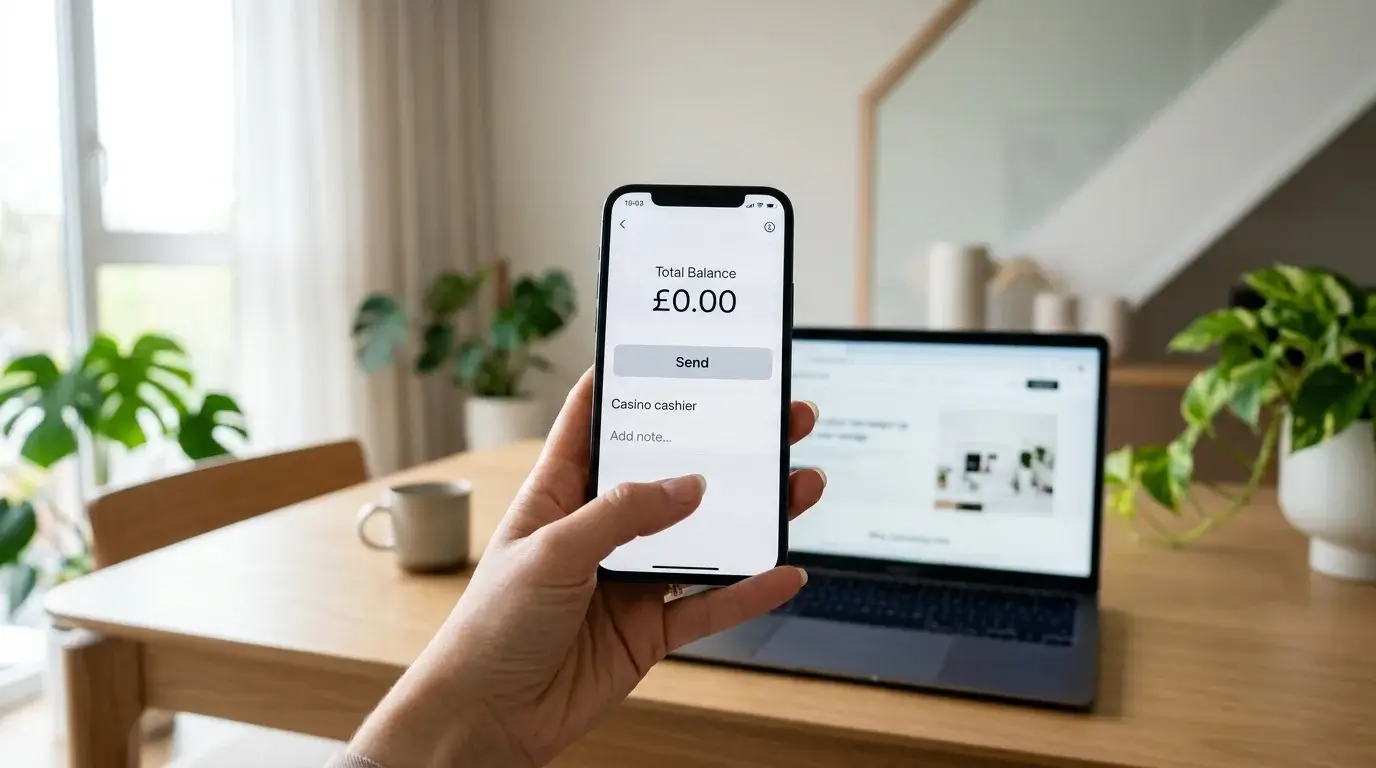
The structural appeal of an e-wallet is that it inserts a layer between your bank and the casino. Your bank sees a transfer to Skrill or to Neteller. Skrill sees a transfer onward to the casino. Each institution sees one leg of the journey. For years that two-step routing was the standard offshore deposit flow, and Skrill and Neteller — both owned by Paysafe — built much of their business on it.
Then the regulators caught up. Skrill and Neteller now apply their own gambling controls aligned with UK rules when the customer is identified as UK-resident. Funding a Skrill wallet from a UK debit card and then attempting to send the balance to a non-UKGC operator triggers the wallet’s own merchant filters in many cases. The wallet itself becomes the gatekeeper that the card network used to be. This is not absolute — there are operators that are still accepted, and the rules vary by wallet and by operator pairing — but the era of “Skrill makes the deposit invisible” ended sometime around 2023.
MuchBetter sits in a slightly different position. It launched specifically as a gambling-friendly wallet, and although it has tightened its UK compliance over time, the wallet is generally more permissive on offshore-facing operators than the Skrill family. It is also more visible at the issuer level, because MuchBetter activity is unambiguously gambling-coded — you cannot pretend the wallet is for groceries. UK banks see MuchBetter top-ups and categorise them accordingly.
EcoPayz, now rebranded as ecoVoucher in much of its product range, plays a similar role with a voucher-style overlay. The voucher product is purchased with one payment method, then the voucher code is used at the casino, separating the two transactions by an additional layer.
The trade-off across all e-wallets is the same: convenience and a measure of intermediation at the cost of an extra account, an extra KYC process, and an extra set of fees. For frequent players the fees are non-trivial — Skrill and Neteller take both deposit and withdrawal cuts depending on currency conversion, and MuchBetter applies fees on inactivity and on certain top-up flows. The wallet is not free intermediation. It is paid intermediation.
Revolut, Monzo and the challenger-bank question
The most asked-about payment topic in my inbox over the past eighteen months has not been crypto. It has been Revolut. Specifically: does Revolut block gambling, will it stop blocking gambling, and what happens if I turn the block off. I will answer that in the wider piece on how Revolut and the other challenger banks actually handle non-GamStop transactions, but the short version is worth setting out here as part of the bigger payments picture.
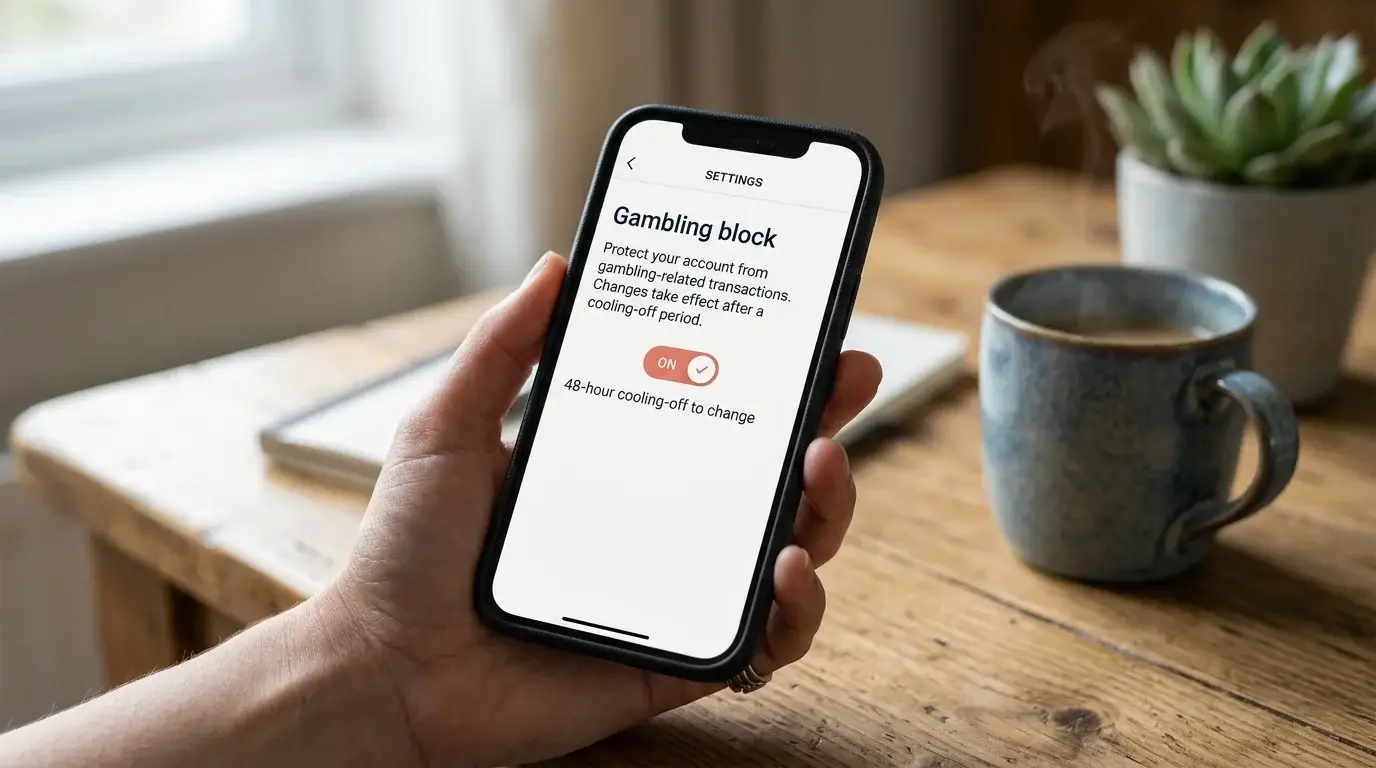
Revolut applies a gambling block by default to new UK accounts. It is a customer setting that can be toggled, but with a cooling-off period before the toggle takes effect — usually 48 hours, sometimes longer depending on the account history. Once the block is off, Revolut behaves like any other UK card issuer: it sees gambling MCCs, it applies its own transaction monitoring, and it will close accounts where it concludes the activity violates its terms. The “cooling off” delay is itself an important player-protection feature, because it interrupts impulsive deposit decisions in a way that legacy banks usually do not.
Monzo runs a comparable system. The gambling block can be turned off, but only after a wait period — Monzo’s is typically 48 hours and the toggle is found in the in-app settings. Like Revolut, Monzo’s transaction categorisation makes gambling spend particularly visible, both to the bank and to the customer’s own spending dashboard. That second part matters: a customer who turns the block off and then continues spending is generating a clear audit trail in their own app that is impossible to ignore in retrospect.
Starling sits in a similar position, with its own toggle-and-delay mechanism. The pattern across the challenger-bank tier is essentially uniform — they treat gambling spend as a category that warrants explicit consent and a cooling-off interval, which is more friction than the high-street banks impose by default.
None of this is unique to non-GamStop operators. The same controls fire against UKGC-licensed sites in the same way. But because the challenger banks are particularly common as primary accounts among younger players, and because non-GamStop registrations among the 16-to-24 cohort have been rising sharply — GamStop’s own data shows a 40% year-on-year increase in registrations from that age band in H2 2025 — the overlap between “challenger-bank user” and “non-GamStop customer” is much higher than the same overlap for older players using legacy banks.
How cryptocurrency deposits actually move
Crypto is the payment rail that has scaled fastest in the offshore market, and the reason is not the one most people assume. It is not anonymity. Anonymity is a side effect, sometimes, and an overstated one. The real reason is that crypto deposits do not touch the UK banking compliance stack at all on the way out, which means none of the friction described above fires.
The standard offshore crypto flow goes like this. The player buys cryptocurrency at a UK-regulated exchange or an offshore one — Bitcoin, Ethereum, or, most commonly in practice, a stablecoin like USDT or USDC. The purchase itself is the moment of UK regulatory visibility: the exchange runs KYC, complies with the UK’s crypto-marketing rules, reports activity to HMRC where thresholds apply. From that point forward, the player holds an asset in a wallet. They can transfer that asset to the casino’s wallet address. The transfer is settled on the relevant blockchain. The casino credits the deposit, usually after a small number of network confirmations.
The reason this matters for the offshore market is captured in one number: Yield Sec’s estimate of the illegal UK gambling market share moved from 0.43% of activity in 2020 to around 9% — roughly £379 million — in the first half of 2025. The trajectory has effectively been a doubling each year since the pandemic, and crypto rails have absorbed a meaningful portion of that growth because they bypass exactly the chokepoints the regulated banking system has been tightening.
Bitcoin is the most universally accepted. Its drawback is volatility and on-chain fee variability — a deposit can confirm in ten minutes or in two hours depending on network congestion, and the fee can run from a few pence to several pounds. Ethereum confirmations are faster but gas fees vary wildly. The reason stablecoins have come to dominate practical offshore deposits is that they remove the price-volatility leg from the equation: a USDT deposit denominated in dollars stays roughly equal to the same number of dollars at withdrawal, so the player is not also taking a market position on crypto.
The Lightning Network sits as a niche option, used by some Bitcoin-native operators to enable instant micro-deposits with minimal fees. Solana and Tron have a presence too, mostly as cheaper alternatives for stablecoin transfers — USDT-on-Tron is by far the most common offshore-deposit configuration I see in operator dashboards I have reviewed in compliance work.
The one piece of crypto mythology I want to dismantle: deposits are not invisible. The blockchain is, by design, a public ledger. A UK-resident player making crypto deposits from a KYC-verified exchange is generating a chain of transactions that HMRC can follow if they choose to, and exchanges regularly receive information requests on suspicious activity. Crypto bypasses the bank. It does not bypass the regulator.

Prepaid vouchers — Paysafecard, Flexepin, AstroPay
Vouchers are the oldest trick in the offshore payment book and they still work, with caveats that have hardened in 2026. The model is straightforward: the player buys a prepaid code at a retail outlet or online vendor, then redeems the code as a deposit at the casino. The code itself is the bearer instrument. The casino sees a voucher payment, not a card transaction from a named individual.
Paysafecard is the most established product in this category. UK players can buy Paysafecard at a wide retail network — newsagents, petrol stations, online vendors — in fixed denominations. The redemption at an accepting casino is essentially instant, and from the operator’s perspective the voucher is settled by Paysafe’s own back-end. The friction sits at the purchase: Paysafecard sales at UK retail are increasingly subject to gambling-related caveats, and online purchases through Paysafe’s own platform apply the same gambling controls the company applies to its e-wallet products.
Flexepin works on a similar voucher model but with a stronger international footprint. AstroPay sits in between — part voucher, part wallet — and is more common at sportsbooks and Latin-America-facing operators that have also opened their doors to UK custom.
The drawback of all voucher methods is that they are deposit-only. Withdrawals do not return to the voucher — the casino has to send the funds back to you via a different rail, usually a card refund (subject to the card-network gambling controls described earlier) or a bank transfer (subject to the open-banking visibility described next). For one-way deposits, vouchers are clean. For a player who actually expects to withdraw winnings, the asymmetry is the catch: the deposit method is not the withdrawal method, and the withdrawal method may have its own frictions you have not encountered yet.

Bank transfers and open banking flows
Bank transfers are the rail that everyone forgets about until they need to move serious money. For larger deposits and withdrawals, particularly at VIP-tier offshore properties, the transfer is often the only realistic option — card-network limits and e-wallet caps cap out long before the operator’s deposit ceiling does.
Direct bank transfers to offshore casinos run via SWIFT or, increasingly, via SEPA where the operator banks in the eurozone. The transfer is visible to your UK bank in full: the destination IBAN, the recipient name, the amount, the reference. The bank’s transaction monitoring sees all of it, which is the polar opposite of the voucher model. If the destination is a known gambling-related payee, the bank may hold the transfer pending a customer call. Larger first-time transfers to offshore destinations almost always trigger that call regardless of the recipient category.
The newer variant is open banking. Several offshore-facing payment providers now offer open-banking initiated payments — the player is redirected to their UK bank’s authentication, approves the payment, and the funds move via the Faster Payments rail. From the bank’s perspective this is a customer-authorised push payment, which carries the same monitoring and categorisation but with the friction of an explicit consent flow on each transaction. The advantage is speed and lower fees. The disadvantage, from the offshore market’s perspective, is that the trail is even cleaner than a voucher because each payment carries a unique consent record.
The pattern across both transfer methods is consistent: faster and cheaper than cards or wallets for larger amounts, but maximally visible to your own bank. They are not the rail you use when you want intermediation. They are the rail you use when you want speed and the visibility is not your concern.
Withdrawal mechanics and the timelines that actually hold
Withdrawals are where reputations are made and broken, and the gap between marketing claims and operational reality is wider on this part of the funnel than on any other. “Instant withdrawals” is a phrase I have learned to translate, in my head, to “instant submission of a withdrawal request that will then be reviewed.”
Every offshore withdrawal moves through three stages, and the timeline of each stage varies by method and by operator. First, the withdrawal request enters the operator’s review queue. Second, the review completes — this is where KYC verification, anti-fraud checks, and any bonus-eligibility audits happen. Third, the payment executes on the chosen rail.
For crypto withdrawals, the review stage typically runs from a few minutes to a couple of hours at well-operated sites, occasionally longer if the player has not previously withdrawn and KYC is being completed for the first time. Once the review clears, the execution itself is fast — a Bitcoin withdrawal might confirm in 10 to 30 minutes depending on network conditions, a USDT-on-Tron withdrawal usually completes in under five. The headline figure most operators publish refers to the execution stage only.
E-wallet withdrawals back to Skrill, Neteller or MuchBetter are usually credited within a few hours once approved, though Skrill and Neteller can apply their own holds. The same review stage applies on the operator side, which is the time-consuming portion.
Card withdrawals — refunds back to the original debit card — are the slowest in practice. The execution stage runs on the same rails as a refund from any merchant: typically two to five business days once submitted, sometimes longer if the issuer’s processing is slow. The review stage at the operator may also take longer because card refund processing requires more reconciliation.
Bank transfer withdrawals to UK accounts via SWIFT run on banking-day timelines: usually one to three business days from the moment the operator releases the payment, plus the operator’s review delay. SEPA is faster within the eurozone but may convert through an intermediary for sterling.
The single most common cause of complaint-worthy withdrawal delays is not the payment method itself. It is KYC being initiated at the moment of first withdrawal rather than at deposit. A new player who has deposited freely without verification, then asked for a withdrawal, suddenly faces a documentation process that can take days. That is not a payment-method issue. It is an operator-process issue, and the cleanest way to avoid it is to complete KYC before depositing, not after winning.

Fees, FX spreads and the charges that nobody warns you about
The advertised “no fees” line on most offshore casino payment pages refers to operator-side fees only. The actual cost of moving £100 to a non-GamStop site and back, on most rails, is somewhere between 1% and 6% in fees and FX spreads — and the breakdown matters because it tells you which methods are actually cheapest for your specific pattern of play.
Card payments through international acquirers usually carry an embedded FX spread when the operator’s settlement currency is not sterling. A casino settling in euros and charging your sterling card converts at a rate the acquirer sets, which is rarely the interbank rate. The visible fee may be zero. The invisible fee — the spread between the rate you got and the rate the bank used for its own books — is real money.
E-wallet flows compound this. A deposit from your bank in sterling into a Skrill wallet, then converted to euros to send to the casino, then converted back to sterling on withdrawal, runs the spread three times. None of the steps shows an explicit “fee” line. All of them cost.
Crypto removes the FX layer if you choose to operate in a stablecoin throughout, but it adds on-chain network fees that vary by network conditions. Tron fees are negligible, Bitcoin can run from pennies to pounds, Ethereum gas is the most variable of the three. There is also a spread at the point of purchase from your fiat — the exchange you bought your USDT from took a margin on the spot price.
Vouchers usually carry an explicit purchase fee built into the retail price, and an implicit one in the conversion rate the issuer applies when crediting the casino in the operator’s settlement currency.
The pattern across all of this is that the cheap-looking methods are rarely cheap and the expensive-looking methods are sometimes the most transparent. A bank transfer with a £15 fee is usually cheaper, in true total cost, than a “free” card payment with a 4% embedded spread on a £500 deposit.
Questions readers send me about payments
Three questions land in my inbox more often than anything else on the payments side, and they are the ones I will close on.
What to weigh before tapping deposit
The mental model that has served readers best, in my experience, is this: pick the rail before you pick the operator. Every payment method I have walked through has a different friction profile, a different fee structure, and a different visibility footprint to your own bank. The right rail for a single small deposit at a curiosity site is not the same rail you would choose if you were running a larger ongoing balance.
A few constants hold across all of them. Complete KYC before you need to. Treat advertised withdrawal times as referring to execution only, not the operator’s review queue. Read the fees that are not labelled as fees — the spreads, the conversions, the network costs — because those are where the real money goes. And remember that the rail is not anonymous. UK banks, exchanges and the regulator have a clearer picture of offshore payment flows in 2026 than they had two years ago, and that picture is sharpening, not blurring.
How long each route takes to pay: withdrawal speed.
Will my UK debit card be blocked by my bank when depositing at an offshore casino?
It depends on three layers in sequence: how the offshore acquirer codes the transaction, whether the card network identifies it as gambling, and whether your specific bank has a gambling block toggled on. Most challenger banks block by default with a cooling-off toggle to enable. High-street debit cards often pass through if the gambling block setting is off, though the bank’s transaction monitoring still sees and categorises the activity. Credit cards are almost universally declined at gambling MCCs by the issuer regardless of where the operator is licensed.
Is a card payment at a non-GamStop casino reported to UK credit agencies?
No. Card transactions to gambling merchants do not produce a credit-file entry the way a missed loan payment would. The transaction is visible to your own bank in its statements and internal monitoring, and may be visible to anyone you subsequently authorise to view your bank statements such as a mortgage underwriter, but it is not reported to the credit reference agencies as a standalone item.
How long does a Bitcoin withdrawal from a Curaçao casino actually take in practice?
The operator’s review stage usually takes between a few minutes and a couple of hours at well-run sites, longer if first-time KYC is being completed at the same time. Once the operator releases the payment, the Bitcoin transfer itself confirms in 10 to 30 minutes depending on network congestion. Total time from request to spendable balance is typically under three hours when KYC is already in place, and one to two business days when it is not.
This material was created by the OFFSTAKE team.
Related posts

Terms of Use for a UK Casino Information Site

Top-Rated Online Casinos UK: Amatic Games Explained