
Non-GamStop Casino Safety: Risks and How Dispute Resolution Works
 Available in GB
The opening line of Andrew Rhodes’s IAGR 2025 keynote has lived in my notes for months because of how cleanly it frames the question this article exists to answer: there is nothing more exploitative than the illegal market. The Gambling Commission’s chief executive said it to a room full of regulators, and the word “illegal” was doing diplomatic work — in the UK frame, any non-UKGC operator serving British customers sits, technically, in that category. The substantive observation, though, is about asymmetry. When the regulatory perimeter is behind you, the structural mechanisms that protect a consumer from a bad outcome are not absent. They are smaller, slower, and weighted differently.
I have spent nine years watching this asymmetry play out in complaint files, withdrawal disputes, KYC delays and the occasional outright fraud case. The protections that disappear when a UK player crosses into the offshore market are not always the ones the player expects. The dispute mechanisms that remain are not always the ones the marketing implies. And the risks that materialise tend to land at predictable points in the customer journey — first withdrawal, large win after a bonus, account closure, payment-fraud event — rather than randomly across the experience.
This piece is meant to walk through what is actually in place, what is not, and where the realistic remedies sit when something goes wrong. There is no alarmism here. Most offshore players never see a serious incident. But a meaningful minority do, and the difference between a contained problem and an open-ended one almost always comes down to whether the player understood the structure of the protections they had — and the ones they did not — before they deposited.
The full picture is in our explainer on non-GamStop casinos.
What protection actually disappears when you leave the UKGC perimeter
A reader once asked me to list, exactly, what they would lose if they moved from a UKGC-licensed operator to an offshore one. I gave them a longer answer than they expected, because the list is not the headline items most people think of. The headline items — GamStop coverage, statutory deposit limits, mandatory reality checks — are real. The structural items are often more consequential.
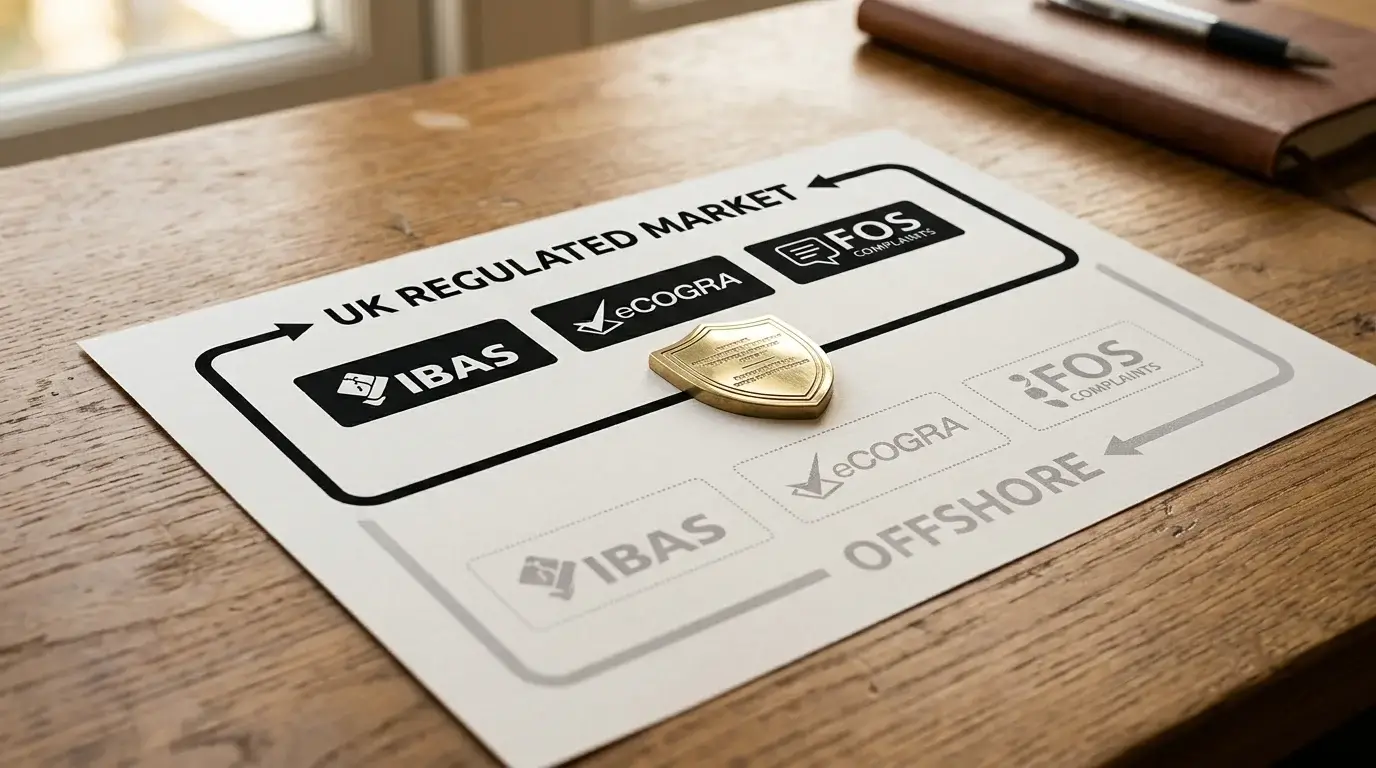
The first structural protection that disappears is approved alternative dispute resolution. UKGC-licensed operators must be members of an approved ADR scheme — in practice that means IBAS, the Independent Betting Adjudication Service, or eCOGRA. Both are independent, both publish their decisions, and both can compel an operator to pay out a disputed amount within the framework of the licensee’s UKGC obligations. Walk off the UKGC list, and ADR options either vanish or shrink to whatever the offshore operator’s own T&C specifies — typically arbitration through a body chosen by the operator, occasionally through a sister organisation. The independence of that body is rarely what it would be at IBAS or eCOGRA.
The second is the regulator’s enforcement reach. Since the start of the 2024/25 financial year the Gambling Commission has issued more than 770 cease-and-desist notices to operators and advertisers, referred over 102,000 URLs to Google with 64,000 ultimately removed from search, and forced 264 sites off their domains entirely. That is roughly a tenfold escalation compared with the year before. Some of that enforcement is directed at unlicensed operators targeting the UK, and the practical implication is that the Commission is actively trying to remove offshore options from the visibility of UK players. As a consumer, this means the regulator is not on your side at the offshore operator in the way it would be at a licensee — but it does mean the Commission has a posture, an active interest, and channels you can report serious incidents through even if you cannot use it for routine disputes.
The third is the statutory framework around player funds. UKGC-licensed operators must hold customer funds at a level of protection specified in their licence — “basic,” “medium” or “high” — with the level disclosed in the terms. Offshore operators, even under the new Curaçao LOK regime, are not required to disclose fund segregation arrangements in the same way. Some do voluntarily. Most do not. The implication, in the event of operator insolvency, is that recovering your balance moves from a documented procedure to whatever bankruptcy law applies in the operator’s jurisdiction.
The fourth is the Financial Ombudsman Service. UK consumers can escalate complaints about UKGC-licensed operators that involve regulated payment activity to the FOS in certain circumstances. The FOS does not adjudicate the gambling activity itself, but it can address payment-side complaints. That route does not extend to operators outside the UK regulatory perimeter.
Dispute resolution at Curaçao-licensed sites in the LOK era
Imagine a player has had a four-figure withdrawal frozen on suspicion of bonus abuse three days after winning. Where does the dispute go, and how long does it take? The Curaçao answer to that question has changed materially since the LOK reform, and the change is still propagating through the operator market in ways that affect what a UK player can realistically expect.
Under the old Curaçao system the dispute path was, in practice, the operator’s own support desk, then the master licensor, then nothing. Master licensors rarely accepted jurisdiction over individual disputes — their commercial relationship with the sub-licensee made independent adjudication structurally awkward. Players who escalated past the master usually found their next port of call was a complaint forum or a regulator with no formal authority over the operator at all.
The new Curaçao CGA regime created, for the first time, a direct supervisory authority that accepts complaints about licensees. The CGA’s complaint portal opened in 2025, and the authority has the power to investigate licensees and impose conditions or revocations on the licence. This is a meaningful upgrade from the master-licensor era. It does not, however, turn Curaçao into the UKGC. The CGA’s resourcing is a fraction of a tier-one regulator’s, complaint timelines run in weeks rather than days, and the authority’s enforcement toolkit is narrower than the Commission’s. The supervisory backbone exists. The throughput is limited.
In practical terms, the dispute path at a Curaçao-licensed non-GamStop site in 2026 runs as follows. First, the operator’s internal complaint process — this can take anywhere from a few hours for routine queries to several weeks for contested withdrawals. Second, if the T&C names an alternative dispute resolution body, escalation to that body — at most CGA-licensed operators this is now a named ADR provider, though the independence of the named provider varies. Third, the CGA’s own complaint portal, if the operator’s process has not produced a resolution. Fourth, in cases involving payment fraud or other serious misconduct, reports to the UK Gambling Commission and to UK police via Action Fraud — these will not produce a refund directly but contribute to the Commission’s enforcement work.
Ismail Vali, who founded Yield Sec and has spent years tracking the offshore market, put the underlying tension cleanly in an iGamingBusiness interview last year: if you set up a scheme like GamStop and you tell vulnerable customers they are safe, surely you should make them safe. The observation is about GamStop specifically, but it captures the structural point about offshore protection generally. A scheme that protects people only when they choose to remain inside it is a different scheme from one that protects them when they leave. A regulator that supervises only its own licensees is a different regulator from one that pursues the consumer’s interest wherever they end up. The CGA is the former. The UKGC has the posture but not the jurisdiction over offshore licensees.
The honest summary is that dispute resolution exists at well-run Curaçao-licensed properties in 2026, takes time, and produces inconsistent outcomes. The worst outcomes I have seen sit with operators on Anjouan or on unmigrated old Curaçao sub-licences, where the regulatory path effectively does not exist as a usable consumer channel.

Our top casino picks for the UK
- x3betBonus: Welcome Pack 100% Up to £1.000 + 200 Free Spins · Payout speed: 1-3 business days
- NightWinBonus: £900 + 400 free spins · Payout speed: 1-3 business days
- Revery PlayBonus: 100% up to€1,000+ 100 FS · Payout speed: 1-3 business days
- DieselwinBonus: Welcome Pack 250% up to £4000 + 200 FS · Payout speed: 1-3 business days
- ChanzeBonus: Slots Welcome Bonus #1 200% up to €500 · Payout speed: 1-3 business days
- BritsinoBonus: Welcome Package – Get your £2,200 + 2,000 FS · Payout speed: 1-3 business days
- SlotoSportBonus: 500% up to £ 10 200+ 777 FS · Payout speed: 1-3 business days
KYC and AML on the offshore side — how the process really runs
The marketing line “no KYC required” appears on a meaningful slice of offshore-facing crypto casinos, and it is one of the most consistently misleading phrases in the industry. The longer truth, which I have laid out at length in a separate piece on how no-KYC casino marketing translates into the actual verification flows UK players encounter, is that “no KYC” almost always means “no KYC up to a threshold, after which the full process kicks in at the worst possible moment.” For the purposes of this article, the shorter version of the same story matters.
Offshore KYC and AML processes are subject to the licensing jurisdiction’s anti-money-laundering rules, which means they do exist at any licensed operator, regardless of how the marketing describes them. Under the Curaçao LOK, licensees must operate AML procedures meeting standards aligned with FATF guidance. Anjouan-licensed operators are subject to local AML rules. MGA operators meet European AML standards. The differences across jurisdictions are real, but the floor is not zero.
What “low-friction” or “no KYC at deposit” actually means in practice is that the operator does not run identity verification at signup or at first small deposits. The verification is triggered by thresholds — cumulative deposit value, withdrawal request size, or risk-rule flags inside the operator’s monitoring. A player who deposits in small amounts, plays in a normal pattern, and never wins enough to request a meaningful withdrawal may never see the verification process at all. The flow has worked entirely on faith, and faith is, technically, the AML compliance.
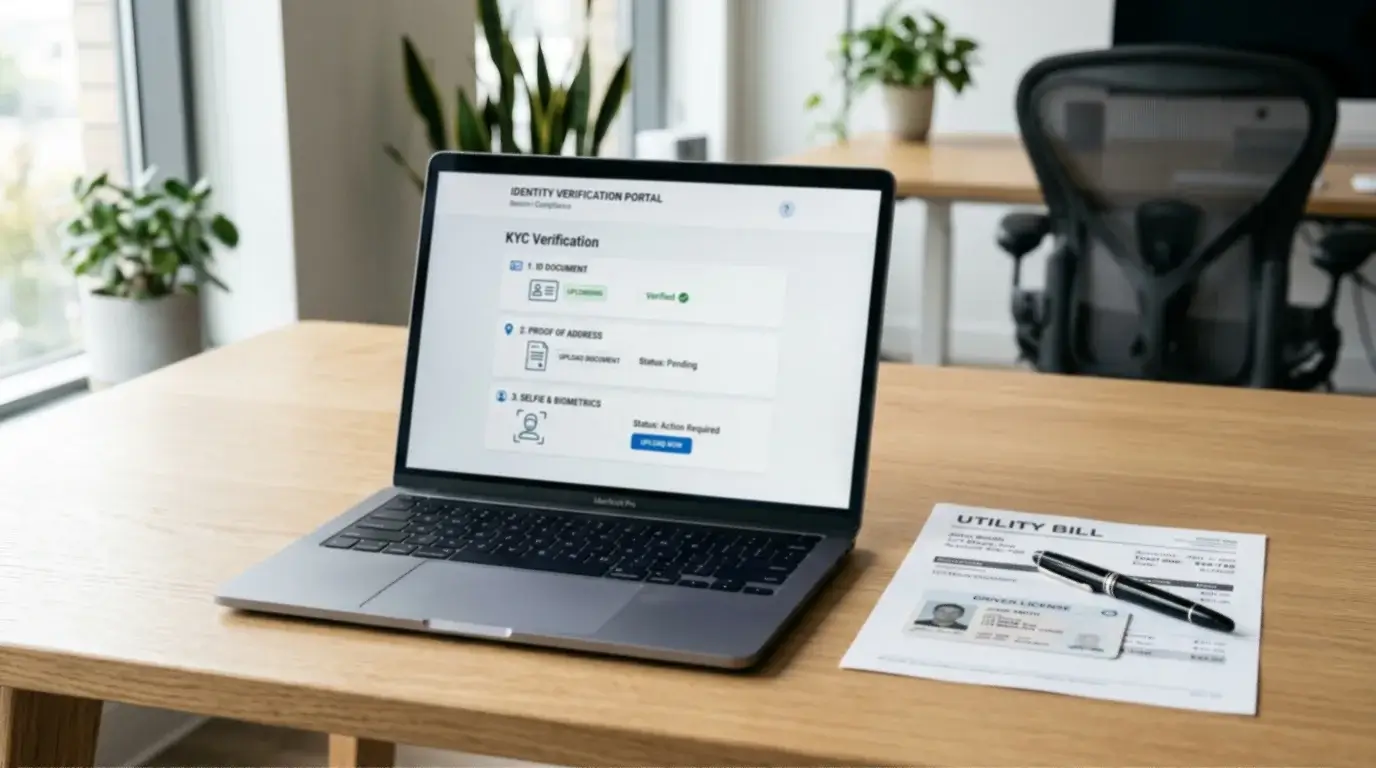
The verification kicks in at the threshold, which is almost always the first significant withdrawal. The documents requested are standard: government ID, proof of address dated within the last three months, source-of-funds evidence for larger balances, occasionally a selfie verification. The process can take from a few hours at well-staffed operators to several days at smaller ones, and the player who has not anticipated it experiences it as a delay applied to their own money at the moment they want it most.
The legitimate version of this is unobjectionable — AML rules exist for reasons that have nothing to do with player friction. The illegitimate version is the operator who uses extended KYC reviews as a way to stall withdrawals on bonus-abuse pretexts, or who reads documents extremely slowly on accounts with large balances. The two are difficult to distinguish from the player side until the process either resolves or does not.
The robust defence against both versions is the same: complete KYC before you need to. Upload documents at registration, not at withdrawal. The friction is identical; the timing is the difference between routine processing and a contested delay.
Withdrawal disputes — the single most common reason players write to me
Roughly six out of every ten reader emails I get about offshore disputes are about a single category: a withdrawal that has either not been paid, has been delayed past the operator’s published timeline, or has been partly voided after a bonus-abuse allegation. The pattern is so consistent that I can recite the operator’s first reply before I have read it.
The mechanics of a typical withdrawal dispute run as follows. The player requests a withdrawal of an amount that is larger than their typical historical pattern. The request enters the operator’s review queue. Depending on the operator’s risk-rule configuration, the request triggers one of three reviews: a routine KYC verification if documents are not on file, a bonus-eligibility review if recent play was bonus-funded, or an enhanced-due-diligence review if the amount is large or unusual. Each review can take from hours to days. During the review the funds sit in a holding state — visible in the player’s account, not paid out.
The most common dispute escalation point is that the review concludes with a partial or full void. The standard reasons cited are: maximum-bet rule breach during wagering, irregular play pattern, breach of bonus terms in a way the player did not anticipate, or — less commonly — an AML concern that the operator declines to elaborate on. The void converts winnings into a smaller payable amount, and the player’s recourse is the dispute path described earlier.
The resolution rates I have seen, across a sample of cases I have helped readers navigate, break down roughly as follows. Withdrawals frozen for KYC clear within five business days at well-run operators once documents are accepted. Withdrawals voided for max-bet rule breach are almost never reversed because the operator’s evidence is the log of the offending spin, which is documented. Withdrawals voided on “irregular play” grounds are inconsistent in outcome — well-documented escalations to a CGA-licensed operator’s complaint portal sometimes produce partial reinstatement, more often they confirm the original void. Withdrawals delayed indefinitely without resolution are the worst category, and the realistic remedy at that point is sometimes a public dispute on a community forum that compels a customer-service response.
The point I want to land is that withdrawal disputes follow patterns. The player who anticipates them — by completing KYC early, by reading the bonus terms before depositing, by keeping records of all play sessions, by not violating max-bet rules — substantially reduces the probability of seeing one. The player who does not is, statistically, the one writing to me.

Bonus-abuse allegations and the mechanics of an account lock
Bonus-abuse allegations and account locks are the second most common dispute category, and the mechanics are different enough from a generic withdrawal dispute that they deserve a separate treatment.
An account lock at an offshore operator typically arrives without warning. The player attempts to log in or to place a bet and finds the session disabled, occasionally with a notification, more often with a generic error and an instruction to contact support. The support response, when it comes, references the operator’s investigation into the account’s activity. The standard reasons are: bonus abuse (the irregular-play clause from the bonus terms), multi-accounting (the player is alleged to have operated multiple accounts at the same operator or its sister sites), payment-source concerns (the funding card or wallet has been flagged), or jurisdictional issues if the player’s identification suggests a restricted country.
The investigative stage at offshore operators ranges from a couple of days to several weeks. During the investigation the balance is held. The player’s leverage in this period is essentially the operator’s reputational concern and the dispute path described earlier. The operator’s leverage is the contractual T&C language allowing it to retain funds pending an investigation.
The honest assessment of these cases, from what I have seen, is that they break into two roughly equal groups. In the first group, the operator’s allegation has substantive grounding — there is evidence of multi-accounting, of bonus terms breach, of payment-method misuse — and the lock holds. In the second group, the allegation is thin and the lock functions, in practice, as a way to claw back a player whose winning pattern has become commercially inconvenient. Distinguishing the two from the outside is almost impossible. Distinguishing them from the inside — with access to the operator’s actual investigation file — is straightforward and rarely available.
The defensive posture against an account lock is the same as against a withdrawal dispute: clean KYC up front, careful bonus-term compliance, no creative interpretation of the max-bet rule, no multi-accounting across sister sites, and documentation of all play. None of this immunises a player from a lock, but each element shifts the balance of evidence toward the player when an investigation runs.
Payment fraud, cloned sites and the look-alike economy
Outright fraud is rarer than the dispute categories above, but the consequences are larger and the recovery path is narrower. The two main forms a UK player encounters are cloned sites and operator exit-scams.
A cloned site is a near-identical copy of a legitimate offshore brand — same name, similar URL, near-identical visual presentation — set up to capture deposits with no intention of operating as a casino at all. The clone goes live, advertises aggressively for a short window, accepts deposits, processes a small number of token withdrawals to seed credibility, then disappears. The sophistication of the clone economy has risen sharply over the past three years. The URLs use plausible domain variations — a hyphen added, a top-level domain swapped, a letter substituted — and the licensing badges on the clone footer are fabricated or borrowed from the legitimate brand.
Ismail Vali, in characterising the broader pattern, captured the targeting logic in a single line at a Peers for Gambling Reform event: you go after the people who have no choice, children and self-excludes. The observation is about the illegal gambling market generally, but it applies to the clone-site economy specifically — the clones target search traffic from players who are already looking outside the regulated market for reasons that make them less likely to verify carefully.
The defence against cloned sites is straightforward but easily skipped. Type the operator’s URL directly rather than clicking from a search-engine ad. Verify the licence number on the regulator’s own register, as I described in the licensing context. Check the operator’s age — a domain registered three months ago is not the offshore brand that has been around for five years. Look for the operator’s presence on independent communities and dispute forums; a real operator has a history, a clone does not.
The second form of fraud is the exit-scam — an operator that has been trading legitimately decides, for commercial or compliance reasons, to wind down and absconds with player balances rather than processing withdrawals. Exit-scams are less common than clones but more financially damaging because the affected players have larger balances and longer relationships with the brand. The warning signs are usually visible in the weeks before — withdrawal delays lengthening, support response times degrading, T&C changes that look defensive, occasionally licence-related news affecting the operator’s parent company. The robust defensive posture is to withdraw at the first signs of operational deterioration rather than to wait for the situation to clarify.

Data protection, GDPR and where your personal information actually lives
The personal information question is one almost nobody asks me about, which surprises me, because the data trail at an offshore casino is more exposed in some respects than at a UK-licensed one and the consumer rights are correspondingly weaker.
UK-licensed operators are subject to UK GDPR — the post-Brexit retention of GDPR rules — and to the Data Protection Act 2018. UK consumers have rights of access, rectification, erasure and portability against them, enforceable through the Information Commissioner’s Office. Offshore operators sit under their home jurisdiction’s data-protection regime. MGA-licensed operators are subject to EU GDPR, which in practical terms is functionally equivalent to the UK regime. Curaçao, Anjouan and Kahnawake operate under data-protection laws that differ from GDPR in material ways — usually with shorter retention periods specified, narrower consumer rights, and no equivalent enforcement authority a UK consumer can directly approach.
The practical implications are two. First, the data you submit at registration — ID document scans, address proofs, source-of-funds documentation — sits in the operator’s storage under the data-protection regime of the operator’s home jurisdiction, which may have weaker safeguards than UK GDPR requires. Second, the operator’s right to share data with affiliates, payment processors and group entities is broader than under UK GDPR, and the disclosures in the operator’s privacy policy reflect this even when the policy reads superficially like a UK-style document.
The robust posture is to read the privacy policy before submitting documents, to confirm the operator’s data-retention period, and to limit the documentation provided to what AML actually requires rather than to whatever the operator asks for opportunistically.
The checklist I run before any first deposit at a new offshore site
This is the list I run through before any first deposit at an unfamiliar operator, in the order I run it. The list is not exhaustive and it is not infallible, but it has caught enough problems over nine years that I treat it as the minimum due diligence.
First, verify the licence. Find the licence number in the footer, navigate to the regulator’s own register directly, search for the operating company name and the licence number. Both must match. If either fails to resolve, stop. The advertising ecosystem around this market — Yield Sec’s analysis indicates that 84% of all illegal gambling advertising aimed at UK consumers is built around the “not on GamStop” search intent — is large enough that fake-licensed sites have substantial reach into search results, and the badge alone is not evidence.
Second, look up the operating company. The T&C names a corporate entity. Find that entity in a company registry — Companies House if it is a UK entity, the relevant offshore registry otherwise. Confirm the company is active, registered for what the casino claims to be, and has been in existence for more than the few months a clone would last.
Third, check the operator’s age and reputation. The footer often shows a “established” date. The domain registration is a separate check via WHOIS. The presence on community dispute forums — players talking about real experiences, including bad ones, with the brand — is the most informative signal. A brand with no community footprint is either too new to have generated one or too clean to have been discussed, and the first is more common than the second.
Fourth, scan the bonus T&C before the deposit. The clauses I described in the bonuses article — withdrawal cap from bonus winnings, country exclusion list, verification trigger, irregular play clause — should all be present and readable. If the T&C is unusually short, unusually vague, or absent entirely, that is a flag.
Fifth, look at the scale of the operator’s marketing. The illegal sector around non-GamStop sites includes roughly 700 unlicensed operators promoted by more than 1,600 affiliates, against around 2,000 licensed operators with 7,000 affiliates. Heavy affiliate coverage with thin operator presence — a name that appears on every “top 10” list but cannot be verified through licensing — is a flag. A real operator is usually findable on the regulator’s register, in business registries, and in independent community discussion in roughly equal measure.
Sixth, do a small test deposit and an immediate withdrawal before committing larger funds. The deposit-then-withdraw test reveals the operator’s KYC behaviour, withdrawal timeline and payment-rail handling cheaply and honestly. An operator that processes a £20 deposit-and-withdraw test in good order is more trustworthy than one whose marketing promises faster service.

Questions readers send me about disputes and KYC
Three questions land repeatedly from readers facing actual disputes. The answers below are the ones I send when the situations are general enough to answer without seeing the specific case file.
Where the risk lands once the UKGC backstop is gone
The single most useful framing I can offer for offshore safety is this: the protections that exist are real, narrower than the marketing implies, and weighted toward players who have done their homework before any incident rather than after one. The structural backbone — licensing supervision, dispute resolution, AML compliance — exists at well-run operators, particularly under the new Curaçao LOK regime. It is slower, less predictable, and more dependent on the operator’s own conduct than the UKGC equivalents.
Who is supervising, if anyone: the licensing overview.
Most offshore players never have a serious incident. The minority that do are disproportionately the players who did not verify licences, did not complete KYC early, did not read bonus terms, and did not run a small test deposit before committing real money. The defensive posture against the offshore risks is not paranoia. It is the routine due diligence that consumer self-protection has always required in markets where regulator oversight is partial. That work shifts from the regulator to the player. The work itself does not disappear.
Can I file an IBAS or eCOGRA dispute against a casino that isn’t UKGC-licensed?
Generally no. Both IBAS and eCOGRA operate as approved ADR providers for UKGC-licensed operators, and their jurisdiction follows the licence rather than the player. Some MGA-licensed operators voluntarily participate in eCOGRA’s wider ADR programme, in which case a complaint route exists but with weaker enforcement teeth than a UKGC equivalent. For a Curaçao or Anjouan licensee, the realistic path is the operator’s internal process, then the regulator’s complaint portal if one is published, then community escalation.
Is a chargeback against an offshore casino realistic for a UK cardholder?
It is possible in narrow circumstances but rarely the right strategy. Chargebacks under Visa or Mastercard rules require a valid reason code, and ‘I lost money gambling’ is not one. Reason codes that work — services not rendered, unauthorised transaction, processing error — apply only when the underlying issue genuinely fits. Successful chargebacks against offshore casinos usually involve clear non-delivery: a deposit accepted with no game access provided, or duplicate processing of the same transaction. Filing a chargeback for a contested withdrawal outcome is more likely to result in the casino closing the account than in funds being returned.
What is the typical KYC process timeline before a first withdrawal at a Curaçao casino?
At well-staffed Curaçao-licensed operators in 2026, KYC completes within 24 to 72 hours of documents being submitted, assuming the documents are clean and the request is straightforward. The timeline extends when source-of-funds documentation is requested for larger balances, when documents are flagged for additional verification, or when the operator’s compliance team is processing a backlog. The mitigation is to submit KYC at registration rather than at first withdrawal, which moves the process out of the cash-out critical path entirely.
This material was created by the OFFSTAKE team.
Related posts

Terms of Use for a UK Casino Information Site

Top-Rated Online Casinos UK: Amatic Games Explained