
Responsible Gambling Without GamStop: Building Your Own Safeguards
 Available in GB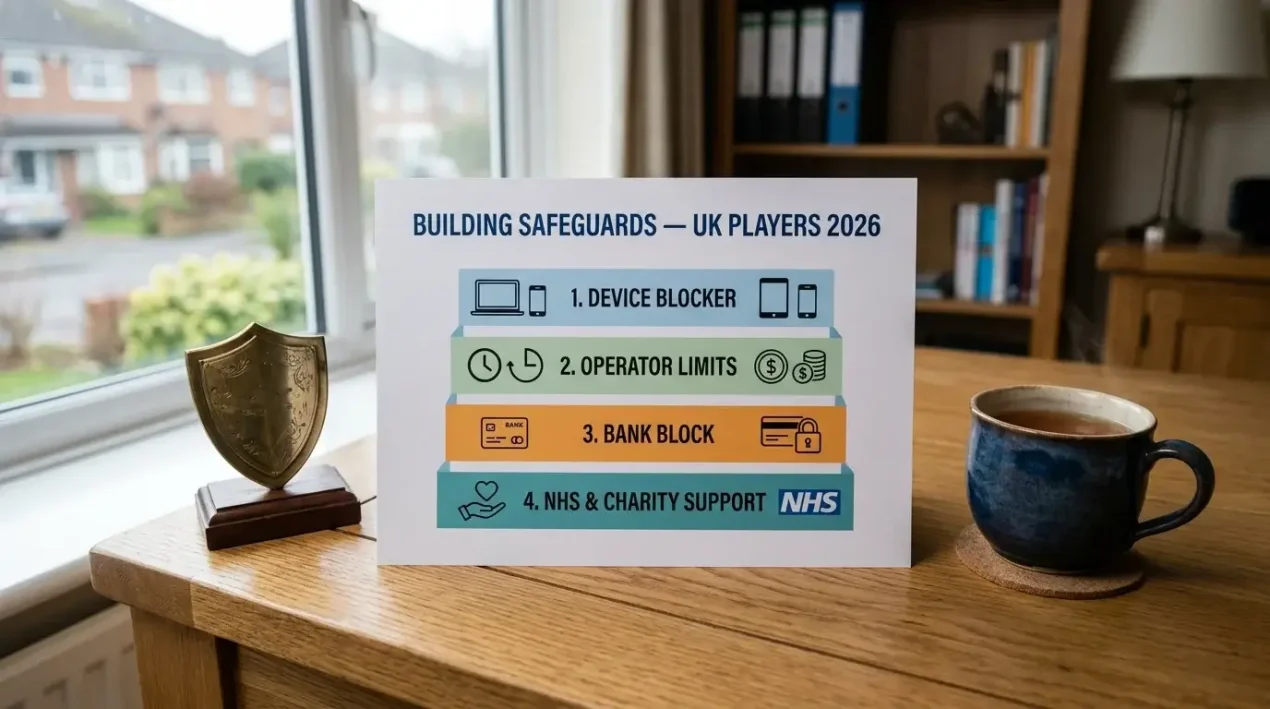
Fiona Palmer, the chief executive of GamStop, said something in an EGR Intel Q&A last summer that I have quoted at conferences several times since: affiliates promoting non-GAMSTOP casinos are absolutely abhorrent. The language is unusually sharp for a regulator-adjacent executive, and the reason it is sharp is that the people most likely to follow an affiliate ad to a non-GamStop site are, by definition, the people who have already taken a deliberate step to remove themselves from gambling — and the affiliate is selling them a route around that step.
The Gambling Treatment Needs Assessment for England estimated in 2024 that around 1.6 million adults in England gamble and potentially need some form of support. That is not a count of people in active crisis. It is a count of people whose relationship with gambling sits anywhere from “could use information” to “needs clinical care,” and the population is large enough that a meaningful share of the readers of this article will recognise themselves somewhere on that spectrum.
This piece is meant to be useful rather than reproachful. The premise is that a UK player who has stepped outside GamStop — or who is considering it, or who never used it but is playing at non-GamStop sites — needs a different set of safeguards than the national scheme provides. The good news is that those safeguards exist, they are layered, and they can be built into a personal framework that does more than the marketing of any single tool implies. The bad news is that no individual tool is a complete substitute for GamStop, and a player who treats one layer as sufficient is usually misjudging their own exposure.
I will walk through each layer in turn, with the resourcing each one actually requires and the limits each one actually has. The National Gambling Helpline run by GamCare is reachable on 0808 8020 133, free, 24 hours a day, and I will mention that number again at the end of this article because the most useful thing this page can do, for some readers, is point them there.
The full picture is in our explainer on non-GamStop casinos.
Why GamStop cannot reach offshore operators
I want to deal with the structural question first because it explains everything else. GamStop is a self-exclusion register administered by the Gamstop Group, and as of the end of 2025 it had around 562,000 active registrations on the books, with nearly 600,000 people having used the scheme at some point since it launched in April 2018. That is a meaningful slice of the UK gambling population and the number has been rising sharply.
The mechanism by which GamStop blocks access is contractual rather than technical. When a UK consumer registers, their identity details are added to a database. UKGC-licensed operators are required, as a condition of their licence, to check the database before allowing a registered account to open or to log in, and to refuse service to any matched user. The block runs through the operator’s own systems. It is not network-level, it is not device-level, and it does not interact with the player’s bank or with the internet itself.
The structural consequence is that an operator outside the UKGC’s licensing perimeter is not obliged to check the GamStop register and, in most cases, does not. Offshore operators run their own KYC checks for AML reasons, but those checks do not include a GamStop database lookup. A self-excluded UK player who registers at a non-GamStop site passes through to a normal account-opening flow because the offshore operator simply has no contractual reason to know that the player is self-excluded back in the UK.
This is not an oversight or a design flaw in GamStop. The scheme was built to operate within the UK regulatory perimeter, and the regulator’s jurisdiction stops at the perimeter. Extending the scheme to offshore operators would require either international regulatory cooperation that does not currently exist or technical blocking outside the operator stack, which neither GamStop nor the UKGC has the remit or the tools to deploy. The gap is a feature of the architecture, not a fixable hole in the implementation.
What this means for a self-excluded player who has accessed a non-GamStop site is that the protection they registered for is not present at the place they are now playing. The other layers — software blockers, bank blocks, operator-side limits where they exist — are what stand between the player and the activity at this point. GamStop is one tool. It was the strongest tool the UK had. Outside its jurisdictional reach, it is not the right tool to lean on.

The UK risk picture in 2026, with the numbers attached
Numbers help here. Not because they tell anyone reading whether their own behaviour is or is not a problem — only a clinical conversation can do that — but because they give a sense of the population the safeguards in the rest of this article are designed for.
The most cited UK figure is from the NHS England Health Survey for England 2024: around 5% of adults show at-risk or problem gambling behaviour by the survey’s screening instrument, and fewer than 1% meet the threshold for “problem gambler” by the same instrument. The 5% figure is the more useful one to hold in mind because it captures a wider band of behaviour — people for whom the relationship with gambling is sub-clinical but worth attention — and because it maps roughly to the 1.6 million-adult figure from the Treatment Needs Assessment.
NHS treatment activity has been rising fast. In the six months from April to September 2024 the NHS specialist gambling clinics in England treated 1,914 people, a 130% increase year on year. By December 2024 there were 15 specialist clinics in operation across England — a network that did not exist at this scale five years ago and that was scaled up to meet demand that was rising faster than the network could accommodate.
The other dataset worth knowing about is GamStop’s own. The scheme recorded 58,675 new registrations in the second half of 2025 alone — roughly 319 per day. The 16-to-24 cohort grew 40% year on year over the same period. April 2025 was the first month in GamStop’s history to exceed 10,000 new registrations, and May 2025 set a fresh record at 10,344. The Monday after the Grand National in April 2025 was the single biggest registration day on record at 437 new users.
These are not abstract statistics. They are the trajectory of a population taking active steps to manage their relationship with gambling, at scale and at increasing pace. The migration of a portion of that population to non-GamStop sites — driven by the regulatory tightening I have walked through in the linked piece on how the affordability check regime has shaped offshore migration in 2025 and 2026 — is the specific reason the safeguards described in the rest of this article matter. The protection people sought when they registered with GamStop is not, on its own, sufficient at the operators they end up at.
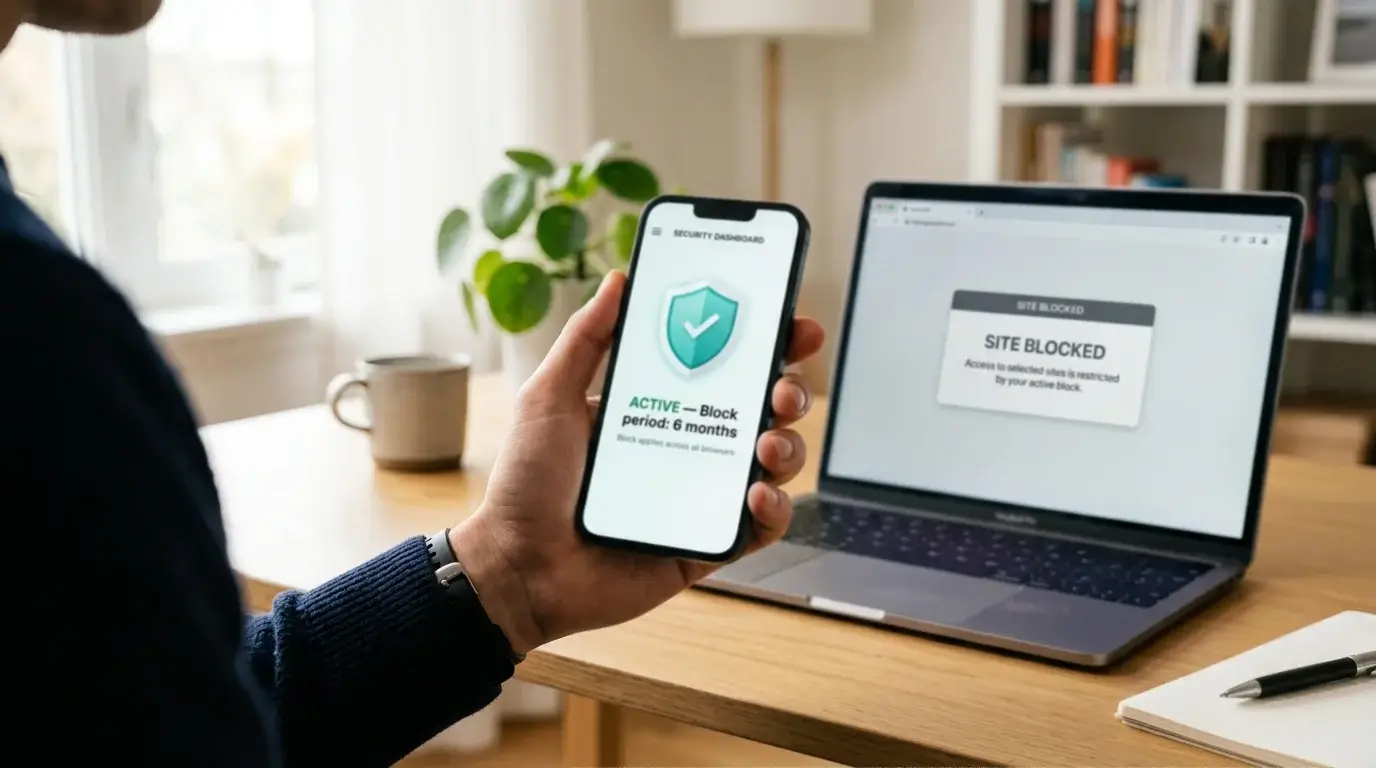
Software-based blockers — BetBlocker, Gamban and the device-level layer
Software blockers are the most direct technical layer available to a UK player who needs a barrier between themselves and offshore gambling sites. They work differently from GamStop and the difference is important: blockers run on the player’s own device, not on the operator’s. They block sites at the network or browser level rather than at the account level. They reach offshore operators because the operator’s licensing status is irrelevant to what the blocker is doing.
BetBlocker is a free non-profit service that installs on phones, tablets and computers. It maintains a continuously updated list of gambling sites — including offshore ones — and prevents the device from loading those sites once the blocker is active. The block period is chosen by the user at activation; once set, it cannot be shortened from the device. Removing the block requires either waiting out the period or a process that involves an external request to BetBlocker, which is deliberately slow. The friction is the point.
Gamban is a paid service with a comparable model and wider device support. It runs on the same principle — a maintained list, applied at the device level, removable only through a friction-laden process — and the maintenance of the list is one of its competitive selling points. Gamban’s coverage of offshore sites is among the most current available, because the company has built operational capacity around tracking new and renamed operators. Subscriptions are inexpensive relative to the harm-reduction value.
Net Nanny and similar parental-control tools provide a related but different layer — they can block gambling categories at the network level, particularly useful on home networks shared between household members. They are not gambling-specific in the way BetBlocker or Gamban are, but they fit the same defensive posture.
The honest limitations of software blockers, which the marketing rarely emphasises, are these. First, they work on the devices they are installed on. A player who installs Gamban on their phone but not their laptop has reduced their exposure but not eliminated it. Second, they can be bypassed by a technically competent user — though the act of bypassing them is itself a meaningful intervention point, because it makes the gambling decision conscious rather than impulsive. Third, they do not interact with the player’s money. The block reduces access; it does not prevent a determined player from finding a route around it through a different device, a friend’s account, or a public computer.
The defensive value is in the friction. A blocker that delays an impulsive access decision by ten minutes or by the time it takes to locate a non-blocked device is, for many players, exactly the intervention that lets a craving pass. The tool is not a replacement for GamStop or for clinical support. It is one layer in a stack.
Operator-side limits — deposit, loss, session and reality checks
Operator-side limits are the layer most readers underestimate, because most non-GamStop sites do offer them — but few advertise them, and almost none make them obvious in the signup flow. The tools exist. The player has to know to ask for them.
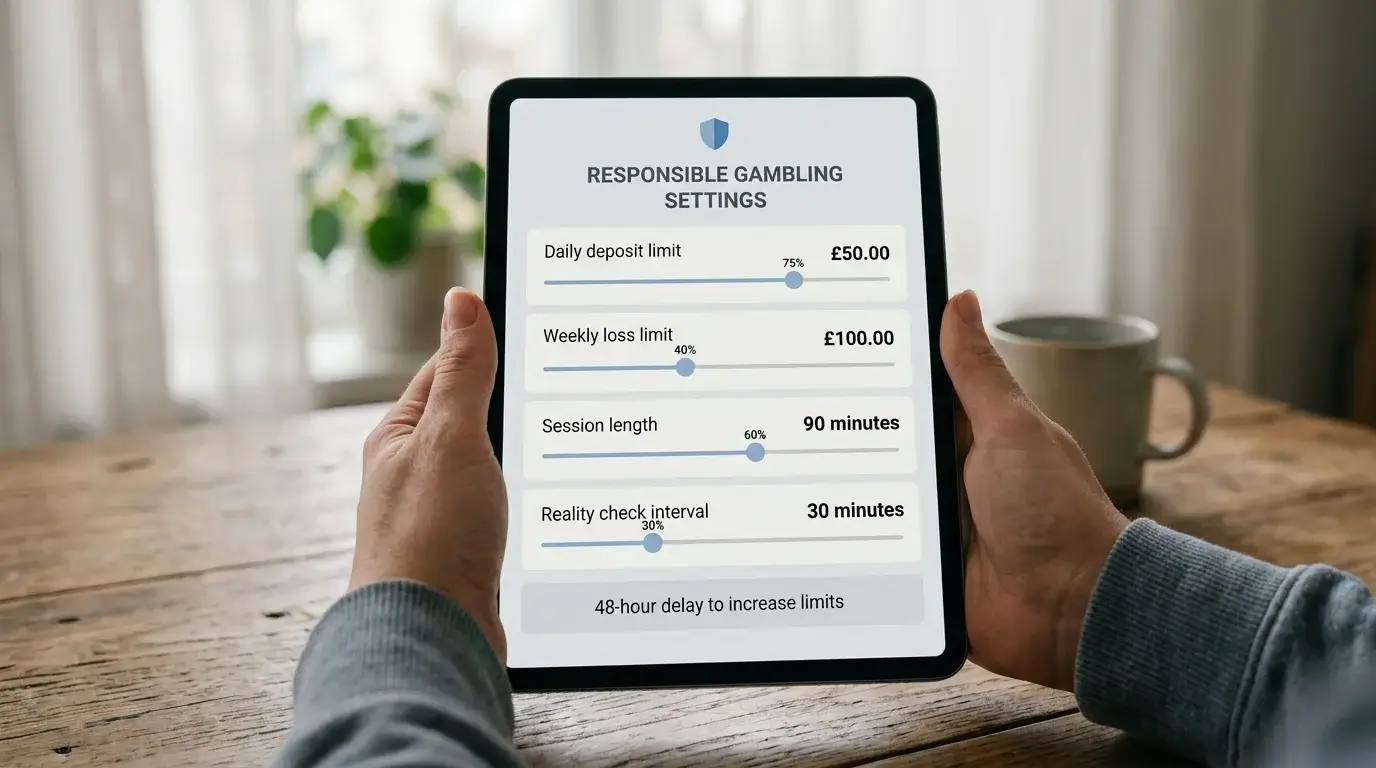
The standard set, across reasonably well-operated offshore casinos, includes four limit types. Deposit limits, applied per day, per week or per month, cap the amount that can be funded into the account in that period. Loss limits cap the net loss across the period rather than the deposit volume. Session limits log the player out after a defined period of continuous play. Reality checks pause the session at fixed intervals — usually 30 minutes or an hour — and display a summary of time and money spent.
The presence of these tools varies by operator. Curaçao CGA-licensed sites in 2026 are increasingly required to offer at least deposit and session limits as part of the licensee’s responsible-gambling obligations, though enforcement of the requirement is patchy. MGA-licensed operators offer the fuller set as a condition of their licence. Anjouan-licensed sites are inconsistent. The first thing to check, before depositing, is whether the operator’s responsible-gambling page lists the tools and explains how to set them.
The mechanical detail that matters is the cooling-off period for limit changes. A well-designed limit system requires a delay — typically 24 to 48 hours — between requesting a higher limit and the new limit taking effect. The delay exists for exactly the reason the limit itself exists: it intervenes between impulse and action. A site that allows limit changes to take effect immediately is offering a tool that the player can disarm in the same moment they need it most. A site without the delay is, in effect, not offering a meaningful limit at all.
One specific product is worth singling out for attention because of the official UK framing around it. Online slots are, in the House of Lords debate on the gambling levy regulations from February 2025, characterised as the highest-risk gambling product. They have the highest rate of binge play and the highest average losses of any online product, and are associated with long playing sessions and high levels of use by people experiencing gambling harm. That framing is worth holding in mind when setting limits at an offshore site, because the product the limits are most needed on is also the product that scales fastest into harmful play. A player who restricts themselves to a single deposit per week but is then unrestricted within the session, on slots specifically, has set a limit that addresses one risk vector while leaving the more consequential one open.
The operator-side limits at a non-GamStop site are a real layer when they exist and when they have the cooling-off mechanic. They are not GamStop equivalent — the player can choose not to set them, the operator may not enforce them rigorously, and the player’s own override is, in the end, available. But used deliberately, they are useful.
Bank-level and card-level gambling blocks
The bank-level layer is the one most readers do not realise they already have access to. Almost every UK bank now offers a customer-toggleable gambling block as a standard account feature. The block works at the card-network level by declining transactions coded to gambling merchant category codes, and it applies regardless of the operator’s licensing status — UKGC or offshore, the MCC is the MCC.
Monzo, Starling, Revolut and the rest of the challenger-bank tier ship with the block on by default for new accounts, with a 48-hour cooling-off to disable. The cooling-off is what makes the block useful as a behavioural intervention rather than just a configuration option. The high-street banks — Lloyds, NatWest, Barclays, HSBC — now offer gambling blocks through their apps, generally not on by default, with reactivation cooling-off periods at most institutions.
The strength of the bank-level layer is that it applies to all gambling MCCs at all merchants regardless of how new an operator is. The limitation is that the block can be circumvented through methods that move money outside the card network: a bank transfer, a cryptocurrency purchase, an e-wallet top-up using a different funding source. The bank sees its own card transactions. It does not see what happens after money leaves the bank.
For most players the strongest configuration combines a software blocker on every device, a bank-level block on every funding account, and operator-side limits at any site they continue to use. The redundancy is the point. Multiple layers, each with its own friction, raise the cost of a bypass to a level where the impulsive decision usually does not survive.
NHS treatment services and the 2025 statutory levy
The clinical layer is the one that matters most when the earlier layers are not enough, and 2025 was the year the UK formally rebuilt how it pays for that layer.
The statutory levy on gambling came into force in April 2025. It is, by design, the funding mechanism for treatment, research and prevention activity related to gambling harm. The annual scale is around £100 million per year, with 50% allocated to the NHS for treatment, 30% to the Office for Health Improvement and Disparities for prevention, and 20% to UK Research and Innovation and the UK Gambling Commission for research. The levy replaced a voluntary industry funding arrangement that had become widely criticised for both inadequacy and structural conflict of interest. The new system is statutory, mandatory, and ring-fenced.
For a UK player thinking about treatment, the practical consequence of the levy is that NHS gambling treatment is funded, accessible, and free at the point of use. By December 2024 there were 15 specialist clinics in England — the National Centre for Behavioural Addictions in London being the longest-established, with regional clinics in Leeds, Sheffield, Manchester, Liverpool, Newcastle, Telford, Norwich, Plymouth, Stoke, Southampton, Sunderland, Coventry, Milton Keynes, and Wessex. Patients can be referred by a GP or, in many cases, can self-refer through the NHS gambling clinic network’s own pathways. The service includes psychological therapy, family support, and where appropriate medical input for co-occurring conditions.
The 1,914 patients treated in the April-to-September 2024 window were a 130% year-on-year increase, and the scaling has continued into 2026. The waiting times to first appointment vary by region but the network has been resourced specifically to keep them shorter than would be standard for non-statutory NHS mental-health pathways. For a player who has reached the point where treatment is the right step, the NHS option is the most substantive resource the UK system offers and it is, in 2026, materially easier to access than it was three years ago.
The wider point of the 2025 levy is that the UK’s posture toward gambling harm shifted from “operators voluntarily fund treatment” to “the state funds treatment as part of its public-health responsibility.” That shift matters for anyone deciding whether to engage with a treatment pathway, because it removes one of the long-standing concerns about whether the funding source compromised the clinical independence of the service.

Support organisations — GamCare, Gordon Moody, Gamblers Anonymous
Alongside the NHS pathway sit three charity organisations that have been doing this work longer than the NHS has been resourced for it. Each one serves a slightly different role, and the right starting point depends on where in the journey a person is.
GamCare operates the National Gambling Helpline on 0808 8020 133. The line is free, available 24 hours a day, and staffed by trained advisers who can talk through any aspect of gambling harm — from “I want to know if my pattern is something to worry about” through to “I need to find treatment now.” GamCare also runs in-person and online counselling through a network of partner agencies across England, Scotland and Wales. The helpline is the entry point I send people to most often, because it does not require a referral, does not require a clinical threshold to be met, and the conversation can be as exploratory or as urgent as the caller needs.
Gordon Moody runs residential treatment programmes for severe gambling addiction — typically 12-week intensive residential courses, supplemented by extended outpatient support. The service is funded through a combination of statutory levy money and charitable contribution. Referrals come through the NHS pathway, through GamCare, or directly from individuals. Gordon Moody’s work sits at the more acute end of the spectrum, for people whose situation has reached the point where outpatient psychological therapy is no longer the appropriate first step.
Gamblers Anonymous runs peer-support meetings on a 12-step model, in person and online, across the UK. The model is mutual support rather than clinical intervention, and the value is in the regular meeting structure and the community accountability. GA meetings are free, anonymous, and do not require any form of referral or eligibility check.
Jenny Watson, the outgoing chair of GamStop, articulated the underlying intent of all of this in her foreword to the GamStop annual report: we have made significant progress in our mission to safeguard people from the harms of gambling addiction, positively impacting hundreds of thousands of lives. Our success is measured not only by the numbers but by the stories of transformation and recovery. The “stories of transformation” framing is not marketing language. It is what the people on the inside of these services see, repeatedly, across the years they spend doing the work.
When the conversation needs to become a clinical one
Fiona Palmer, GamStop’s chief executive, observed in the scheme’s 2025 annual report that our data shows a significant spike in the number of younger consumers who are Gamstopping to manage their gambling, and this has driven the record registrations in 2025. The line is worth holding onto because it changes the shape of who I am talking to when I write about this. The image of the gambling-affected person as a middle-aged man with a long-running pattern is increasingly out of date. The 40% year-on-year increase in 16-to-24 GamStop registrations through 2025 has shifted the demographic substantially, and the conversation about “when to seek help” has to start from a more honest place than it used to.
The signs that a relationship with gambling has moved past self-management into territory where professional support is the right step are, in my experience reading these emails, more practical than diagnostic. The person who can no longer accurately predict how much they will lose in a session. The person who has chased a loss across more sessions than they would have admitted to a week earlier. The person whose play has started affecting work attendance, sleep, financial obligations to others, or relationships with people they love. The person who has set a limit and overridden it, set another limit and overridden that one. The person who has installed a software blocker and then circumvented it. The person who keeps the activity hidden from the people around them.
None of these is a clinical threshold and none of them on its own diagnoses anything. The honest reading is that any one of them, sustained over weeks, is a reason to make the call to 0808 8020 133 — not because the situation is necessarily severe, but because the conversation with a trained adviser is the right next step to figure out what the situation actually is. The helpline call is a low-cost diagnostic conversation. The GP referral, the NHS clinic appointment, the Gordon Moody assessment — those are the higher-intensity steps that follow if the helpline conversation indicates they are appropriate.
The other thing I want to say plainly: there is no failure in making the call. The 562,000 people on GamStop made a version of the same choice. The 1,914 patients in the NHS clinics during one half-year window made a more involved version of it. The infrastructure exists because the situation is common enough that the UK has, over the past decade, built a public-health response to it. Using that infrastructure is what it is for.

Questions readers send me about staying safe outside GamStop
Four questions land most often from readers thinking about their safeguard stack. The answers below cover what I find myself repeating most frequently.
Building a layered safeguard you can actually live with
No single tool replaces GamStop at an offshore site. The structure of the offshore market is what it is, and the protection a UK player wants has to be built rather than registered for. The good news, after walking through the layers, is that the materials to build it are all available — software blockers at the device level, bank blocks at the card level, operator-side limits where the operator offers them, and clinical support on the NHS and through the charity sector when the situation calls for it.
The layered approach is the one I would put together if I were starting from scratch. A software blocker on every device the player uses. A bank-level block on every funding card. Operator-side limits with cooling-off mechanics at any site the player continues to use. A small number of saved support contacts — GamCare on 0808 8020 133, the local GP for NHS referral, Gordon Moody if the situation has reached that intensity, a Gamblers Anonymous meeting schedule if peer support fits the person’s style. Each layer is imperfect. The stack of them is more robust than the marketing of any single layer would suggest.
What offshore protection actually covers: the safety guide.
The National Gambling Helpline number is worth saving in your phone before any of the other steps in this article. 0808 8020 133. Free, 24 hours a day, run by GamCare. The conversation does not have to be a crisis call. It can be a question. Most of the calls the line takes are exactly that.
What software blockers actually cover non-GamStop sites?
BetBlocker (free, non-profit) and Gamban (paid, broader device support) are the two most commonly used. Both maintain continuously updated lists of gambling sites that include offshore operators, and both apply at the device level rather than the account level — so the operator’s licensing status is irrelevant to whether the block works. Both have deliberate friction on removal, which is what makes them useful as behavioural interventions rather than just configuration options. Coverage of newly launched offshore sites varies; Gamban’s operational capacity for tracking is generally faster than BetBlocker’s, though BetBlocker’s price point is zero.
Can my UK bank stop me depositing at an offshore casino?
It can stop card transactions to gambling merchant category codes if you have the gambling block toggled on. Monzo, Starling and Revolut block by default with a 48-hour cooling-off to disable; most high-street banks now offer the block but require explicit activation. The block applies to card payments only — it does not catch bank transfers, cryptocurrency purchases, or e-wallet top-ups funded from other sources. For most players the bank block is most useful as one layer in a stack rather than as a standalone protection.
Is there a way to extend or shorten my existing GamStop period?
A GamStop exclusion can be extended at any time by contacting GamStop directly — the process is straightforward and the new period takes effect immediately. Shortening an existing exclusion before it expires is deliberately not available; once a period is set, it runs to its end. Among 16-to-24-year-olds the 6-month option is the most popular choice at registration (38% of registrations in this age band), and across all ages, 47% of GamStop users in 2025 chose the maximum 5-year period — with more than half of those opting into auto-renewal in December 2025, which is functionally a permanent block.
How do NHS gambling clinics work, and who is eligible to be referred?
The NHS network in England runs 15 specialist clinics as of late 2024, treating people whose gambling has reached the point where structured psychological therapy is the appropriate intervention. Referrals can come from a GP, from GamCare or another support agency, or in many cases through direct self-referral via the clinic network’s own pathways. Treatment is free at the point of use, funded through the 2025 statutory levy. There is no minimum severity threshold to be assessed; the assessment itself is part of the service.
This material was created by the OFFSTAKE team.
Our top casino picks for the UK
- x3betBonus: Welcome Pack 100% Up to £1.000 + 200 Free Spins · Payout speed: 1-3 business days
- NightWinBonus: £900 + 400 free spins · Payout speed: 1-3 business days
- Revery PlayBonus: 100% up to€1,000+ 100 FS · Payout speed: 1-3 business days
- DieselwinBonus: Welcome Pack 250% up to £4000 + 200 FS · Payout speed: 1-3 business days
- ChanzeBonus: Slots Welcome Bonus #1 200% up to €500 · Payout speed: 1-3 business days
- BritsinoBonus: Welcome Package – Get your £2,200 + 2,000 FS · Payout speed: 1-3 business days
- SlotoSportBonus: 500% up to £ 10 200+ 777 FS · Payout speed: 1-3 business days
Related posts

Terms of Use for a UK Casino Information Site

Top-Rated Online Casinos UK: Amatic Games Explained