
Free Spins at Non-GamStop Casinos: The Math Behind 100 Free Spins
 Available in GB
A player I worked with last spring sent me a screenshot of a promotional banner: “Get 200 free spins on deposit!” His question was reasonable — how much was that actually worth? The honest answer involved opening the bonus terms in a new tab and reading three paragraphs of conversion mechanics. The headline number is almost never the operating number. Yield Sec’s measurement that 84% of UK illegal gambling ads use “not on GamStop” search intent indicates the scale of marketing using these spin allocations as headline hooks. This piece walks through the spin value math, the eligible-slot restriction, max-win caps, wagering treatment of spin winnings, and the expiry mechanics that determine whether a free-spins offer is genuinely valuable or marketing theatre.
The full picture is in our explainer on non-GamStop casinos.
Spin Value: The Hidden Number
The spin value is the per-spin stake that the operator credits when triggering a free-spin allocation. A “100 free spins” headline almost never means 100 spins at the slot’s normal stake range. The operator selects a per-spin value — typically 10p or 20p, sometimes 25p, rarely higher — and the 100 spins run at that value. A 100-spin offer at 10p per spin is functionally a £10 cash-equivalent allocation. A 100-spin offer at 20p per spin is £20 equivalent.

The spin value is usually disclosed in the bonus terms but not in headline marketing. A player who expects “100 free spins” to mean 100 spins at their normal £1 or £2 base stake will be disappointed when the spins arrive at 10p. The mathematical implication is straightforward: the total expected value of a free-spins offer is roughly equal to the number of spins multiplied by the spin value multiplied by the slot’s RTP. A 100-spin offer at 10p on a 96% RTP slot has expected value of approximately £9.60. The maximum theoretical outcome is capped by the slot’s max-win and the offer’s max conversion.
The spin value is also constant across all spins in the allocation. There is no escalation, no doubling, no random multiplier. Each spin is identical to the next. The variance comes from the slot’s volatility profile rather than the spin allocation structure. Higher-volatility slots produce wider win distributions per spin; lower-volatility slots produce smoother accumulation.
Our top casino picks for the UK
- x3betBonus: Welcome Pack 100% Up to £1.000 + 200 Free Spins · Payout speed: 1-3 business days
- NightWinBonus: £900 + 400 free spins · Payout speed: 1-3 business days
- Revery PlayBonus: 100% up to€1,000+ 100 FS · Payout speed: 1-3 business days
- DieselwinBonus: Welcome Pack 250% up to £4000 + 200 FS · Payout speed: 1-3 business days
- ChanzeBonus: Slots Welcome Bonus #1 200% up to €500 · Payout speed: 1-3 business days
- BritsinoBonus: Welcome Package – Get your £2,200 + 2,000 FS · Payout speed: 1-3 business days
- SlotoSportBonus: 500% up to £ 10 200+ 777 FS · Payout speed: 1-3 business days
Eligible Slot List and Restrictions
Every free-spins offer specifies an eligible slot or a small eligible-slot list. The selection is operator-determined, with the studio supplying commercial terms for being featured in promotional offers. The perennial favourites — Starburst (NetEnt), Book of Dead (Play’n GO), Sweet Bonanza (Pragmatic Play), Gonzo’s Quest (NetEnt), Big Bass Bonanza (Reel Kingdom) — appear repeatedly because their volatility profiles and bonus mechanics align with the operator’s interest in smooth bonus conversion. The UK regulated remote casino vertical produced £7.8 billion in RCBB between April 2024 and March 2025, with these specific titles among the most-played in that segment, which feeds the operator’s confidence in their conversion behaviour.
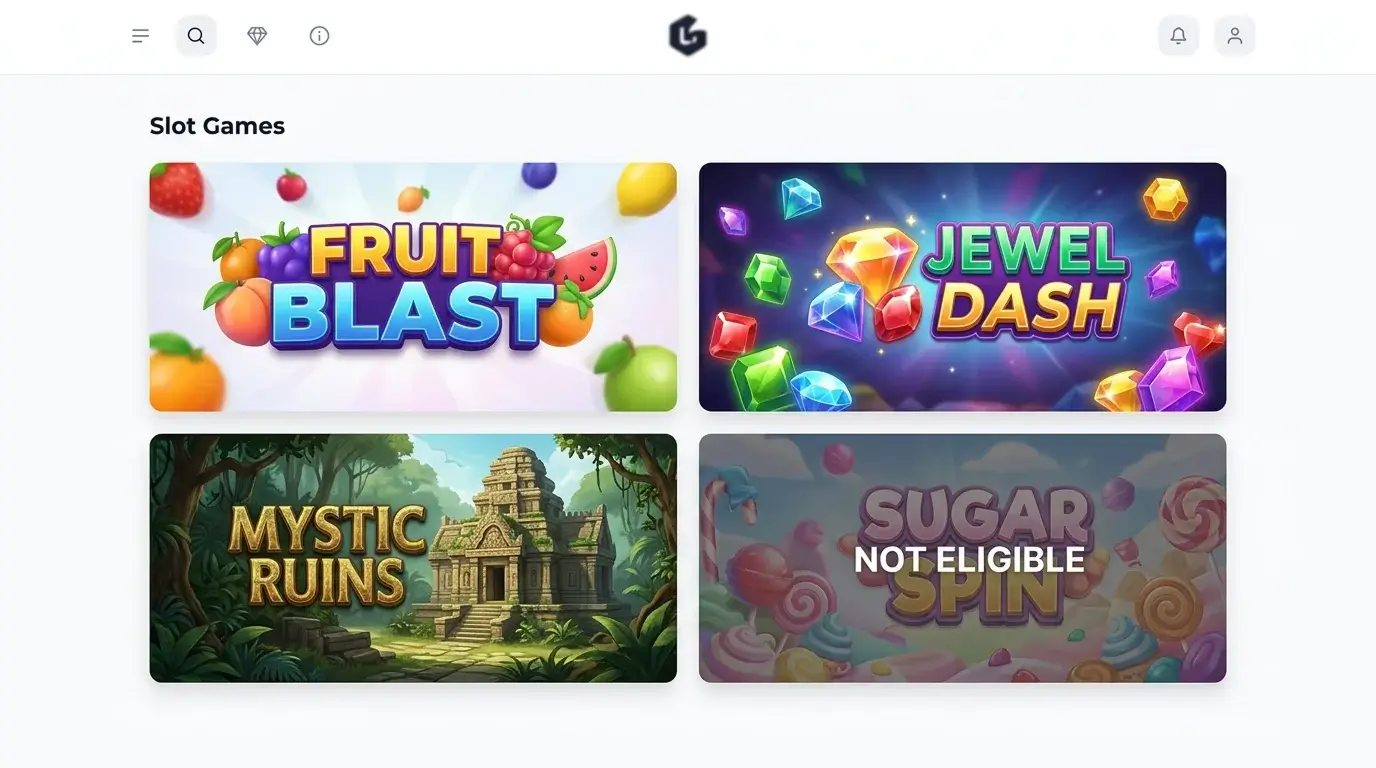
The eligible-slot restriction matters because a player cannot transfer the spin allocation to their preferred title. Free spins assigned to Book of Dead must be played on Book of Dead. Some operators allow a choice from a list of three to five slots, but the choice is bounded. The slot’s volatility profile — Book of Dead is high-volatility, Starburst is low-volatility — determines the variance distribution of the spin session.
If the eligible slot is unavailable in the player’s region — for example, NetEnt titles being geo-restricted at some operators — the operator typically substitutes an alternative slot from a fixed list. The substitution does not preserve the original offer mathematics exactly; the spin value remains constant but the slot RTP and variance differ. Checking the eligible slot at promotion claim avoids the substitution surprise.
Max Win Cap on Free Spin Output
The max win cap on free-spin output is the ceiling on what the spin allocation can produce, regardless of the slot’s published max-win. A typical offshore free-spins offer carries a max-win cap of £50 to £200 on the total winnings from the allocation. The slot’s max-win might be 5 000x stake or higher — meaning theoretical maximum of £500 per spin at 10p stake — but the offer’s max-win cap truncates outcomes at the lower number.

The cap matters most on high-volatility slots where rare large outcomes are possible. A Book of Dead spin can theoretically pay 5 000x stake on a maximum hit; at 10p stake that is £500 from a single spin. If the offer’s max-win cap is £100, the player sees £100 in their bonus wallet, not £500. The difference is forfeit. The cap protects the operator’s downside exposure on what is essentially a free product, and it shapes the realistic upside of any free-spins session.
The cap also interacts with the wagering requirement. Winnings above the cap are stripped immediately at the point of accrual on most platforms — once you hit the cap, additional wins do not accumulate. On some platforms the cap applies after wagering completes, with intermediate wins counting toward wagering progress even if they exceed the cap. The terms vary by operator and should be checked before relying on the cap structure to plan stake.
Wagering on Spin Winnings Mechanics
Wagering requirements on free-spin winnings run between 30x and 50x at offshore casinos, applied to the winnings from spins rather than to the spin allocation itself. If a player wins £30 from a 100-spin offer at 10p per spin, and the wagering requirement is 40x, the player must turn over £1 200 in qualifying bets before the £30 (capped if necessary at the max-win cap) becomes withdrawable. The wagering is typically slot-only, with table games and live casino either excluded or contributing at 10% to 20%.

The maximum bet during wagering is typically capped at £5 per spin to prevent players accelerating wagering completion with large single bets. The cap is published in the terms and enforced through platform-layer bet rejection. Players attempting to exceed the cap see their bet rejected with a wagering-violation message; persistent attempts can trigger account flag and bonus forfeiture.
The practical wagering completion time on a 100-spin offer with a £30 win and 40x wagering — £1 200 in qualifying stake at the max £5 bet — is roughly 240 spins at the cap, or one to two hours of active play. The variance during that wagering session can produce additional wins or full bonus depletion before completion. The expected outcome of wagering depends on the slot’s RTP applied across the £1 200 stake — at 96% RTP, the expected outcome is loss of £48, meaning the £30 in bonus wallet plus typical reinvested winnings during wagering produces an expected net outcome below the original £30 win.
Expiry Windows and Batched Release
Free-spin allocations come with expiry windows that vary by operator. The standard is 7 days from credit, with shorter windows (24 hours, 72 hours) used for promotional offers and longer windows (30 days, 60 days) reserved for VIP loyalty allocations. The window applies to the spin allocation itself — spins not used by expiry are forfeited — and separately to any winnings, which carry their own wagering window of typically 14 to 30 days from win.

Batched release is a structural feature of larger spin offers. A “200 free spins” headline is often delivered as 20 spins per day across 10 days rather than 200 spins on day one. The batched structure is operator-friendly because it requires the player to log in repeatedly, increasing engagement and the probability of additional deposits. From the player’s perspective, batched releases extend the effective expiry window but require active log-in to claim each batch.
The playthrough attached to them: wagering requirements.
What the Spin Allocation Actually Delivers
Stripped down, a 100-spin offer at 10p per spin on a 96% RTP high-volatility slot with 40x wagering and £100 max-win produces an expected net outcome to the player of somewhere between £0 and £20 of withdrawable cash, with most outcomes clustering in the £0 to £10 range and rare outcomes reaching the cap. The expected value is positive — the offer is genuinely free — but the distribution is wider than headline numbers suggest. The marketing function of free spins is to drive registration and first deposit; the player value is real but smaller than the marketing implies. The next category of offshore bonus offer with structurally similar mechanics is cashback, where the calculation moves from upfront credit to back-end loss reimbursement; cashback offers at non-GamStop casinos works through that math.

Why does ‘100 free spins’ often translate to £20 effective value at non-GamStop sites?
The headline number counts the spin allocation; the effective value is the spin count multiplied by the per-spin stake. Most offshore free-spin offers run at 10p or 20p per spin, which makes a 100-spin allocation worth £10 to £20 in stake-equivalent terms. The player can still win above that figure depending on slot variance, but the underlying allocation that drives the math is the £10 to £20 of effective stake the operator has committed.
What happens to free spin winnings if the eligible slot is unavailable in my region?
The operator substitutes an alternative slot from a fixed list specified in the bonus terms. The spin value and number of spins typically remain unchanged, but the slot’s RTP and volatility profile may differ, affecting the expected outcome of the session. Substitution is automatic at the platform level rather than requiring player action. Checking the eligible slot before claiming the offer is the simplest way to avoid an unexpected substitution.
This material was created by the OFFSTAKE team.
Related posts

Terms of Use for a UK Casino Information Site

Top-Rated Online Casinos UK: Amatic Games Explained