Crypto Casinos Not on GamStop: How the Deposit-to-Withdrawal Flow Works for UK Players
 Available in US
The first crypto casino deposit I ever traced from end to end took six minutes from wallet to play balance, and the casino’s marketing page promised “instant.” Five years on, the same flow is closer to ninety seconds — sometimes faster, sometimes slower, but no longer the novelty it was. What has stayed remarkable is how completely the crypto rail has shifted the economics of non-GamStop casinos for UK players.
The illegal share of UK online gambling has grown from roughly 0.43 per cent in 2020 to around nine per cent in the first half of 2025, according to Yield Sec’s measurement — and a meaningful portion of that growth has come on crypto rails. I want to walk through how the flow actually works at a non-GamStop casino that takes Bitcoin, Ethereum, USDT and a handful of other coins, because the difference between the marketing description and the real operational picture is where most of the confusion happens.
Why crypto and non-GamStop overlap so heavily
If you’d asked me in 2019 whether crypto would become the default rail for offshore gambling, I would have said the technology would help but the friction was too high — wallets, gas fees, confirmation delays, regulatory uncertainty all stacked against mass adoption. The thing I underestimated was how much harder the fiat rails would get in the same period.
UKGC tightening between 2020 and 2025 squeezed the regulated card market — credit cards banned in 2020, affordability checks at a £150 net-deposit threshold from February 2025, stake caps of £5 and £2 introduced through 2025. None of that is unreasonable from a consumer-protection standpoint, but it pushed a segment of players towards channels where those controls don’t apply, and crypto was the channel waiting. There was also a parallel surge in pirate streaming as a marketing vector — 3.1 billion pirate sports-stream views were recorded in the UK in 2024 and 1.6 billion in the first half of 2025 alone, with crypto casinos prominent among the advertisers behind those streams. The result is that the crypto-casino segment is no longer a niche of cypherpunks. It is a meaningful share of offshore activity, and most of the operators on it accept the same UK customers who used to be served by UKGC sites.
The deposit flow from wallet to balance
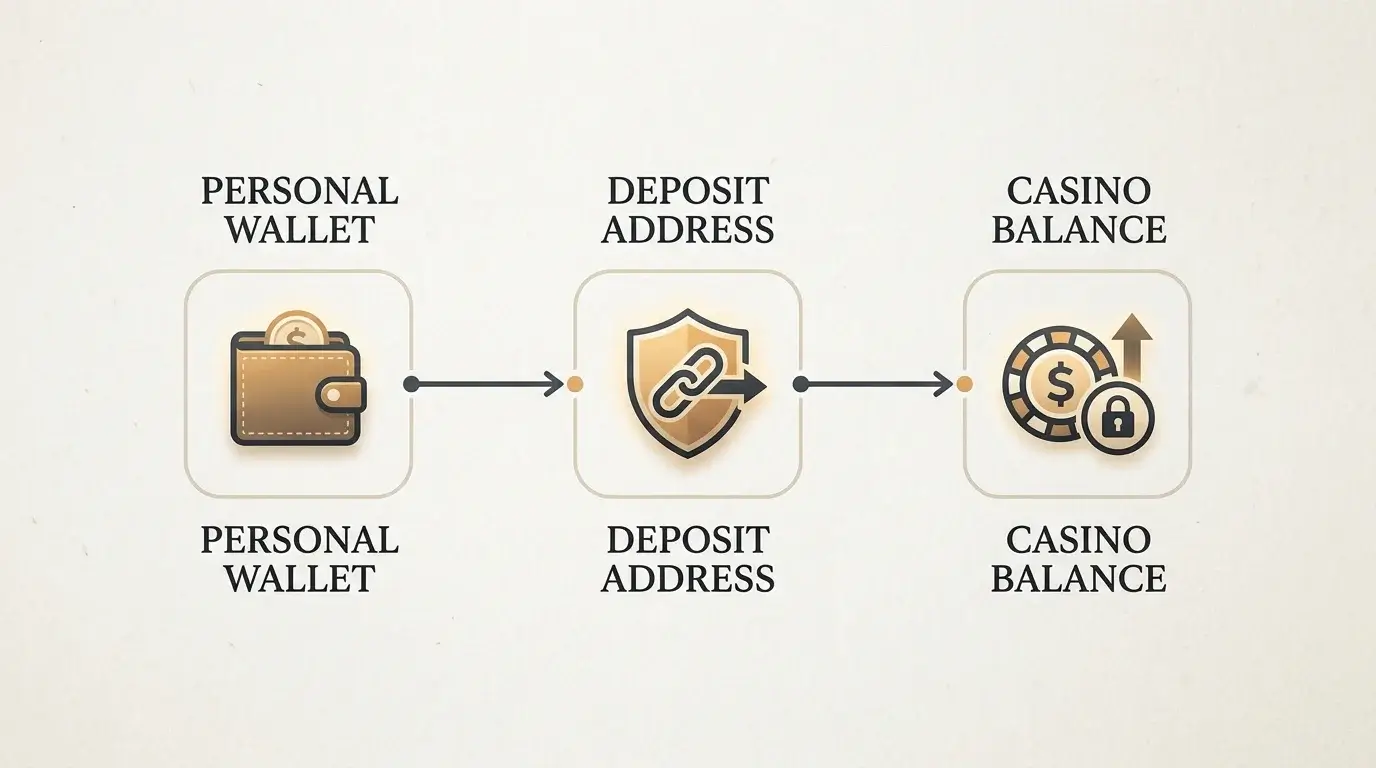
Strip away the branding and a crypto deposit at a non-GamStop casino works the same way at almost every operator. You pick a coin from the cashier. The casino generates an address — usually a one-time deposit address belonging to the operator’s hot wallet — and shows you a QR code along with the alphanumeric string. You send the coins from your personal wallet to that address, the network confirms the transaction, and the balance lands on your account.
What varies between operators is the policy layer wrapped around that flow. Three things in particular. First, the number of confirmations required before the deposit credits — Bitcoin sites usually want one to three confirmations, Ethereum and the major Layer-1s typically credit on a single confirmation, and Lightning Network Bitcoin payments are effectively instant. Second, whether the deposit is held in the original coin or auto-converted to a base currency at the moment of credit. Some sites maintain BTC balances all the way through; others convert immediately to USDT or GBP at the deposit timestamp. Third, the deposit address policy — some operators rotate addresses on every deposit, others give you a permanent address tied to your account. Permanent addresses are convenient and they are also a privacy regression, because they let anyone with the address see your deposit history on-chain.
The other thing worth knowing about the deposit step is what happens if you send the wrong amount, the wrong coin, or to the wrong address. Bitcoin sent to an Ethereum address is gone. USDT sent on the wrong network (TRC-20 versus ERC-20) is recoverable only if the operator’s wallet supports the alternate network and is willing to do the manual reconciliation. The cashier flow is forgiving in interface terms but unforgiving in transaction terms, and a missed network selection is the most common avoidable loss I see in dispute logs.
Which coins actually appear in the cashier
The set of coins on a typical non-GamStop crypto casino in 2026 is narrower than the early days suggested. Six or seven coins do almost all the volume — Bitcoin, Ethereum, Tether on at least two networks, Litecoin, Tron, occasionally Solana, and a handful of operator-specific additions like Dogecoin or BNB. The long tail of altcoins that some operators advertised in 2021 has shrunk because the operational overhead of supporting them outweighs the marginal volume they brought.
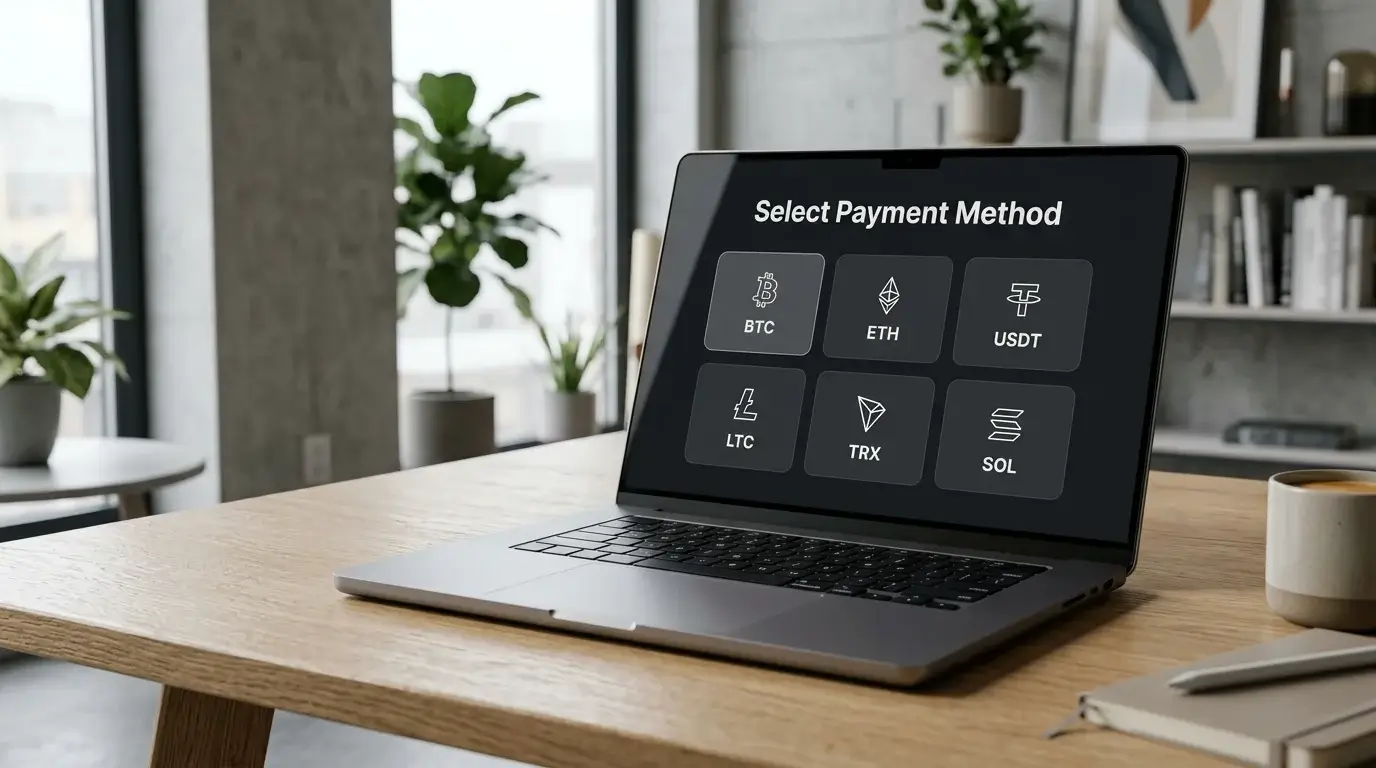
Bitcoin sits at the top for symbolic reasons — it is the coin most players recognise — but in terms of actual deposit and play volume, USDT has overtaken it on many sites. The reasons are obvious once you watch a few sessions. USDT does not move in value during a session, so the balance you started with is the balance you can spend; Bitcoin can drift two per cent in an hour, which turns a session of low-house-edge tables into a currency play on top of a gambling play. Operators have noticed the preference and now build their cashier defaults around stablecoins rather than headline coins.
Ethereum and Tron occupy the middle of the table, mostly because they are the networks USDT moves on. Litecoin is a fast-and-cheap alternative for players who don’t want to deal with stablecoin network selection. Solana is gaining ground for its speed and low fees, though not every operator yet supports it.
Withdrawal mechanics and confirmation windows
Withdrawals are where the difference between operators stops being theoretical. The marketing pages say “instant” with cheerful confidence. The reality runs through three windows — a pending-review window on the casino side, a processing window where the transaction is being prepared and broadcast, and a network-confirmation window once the transaction is on-chain.
The first window is the one that decides everything. At a well-run operator with your KYC already complete, the pending-review can be five minutes or under. At an operator with KYC outstanding, or with anti-fraud triggers fired on the account, the window can extend to twenty-four or forty-eight hours regardless of which coin you’re withdrawing. The headline “instant” applies only after the pending-review releases.

Once the transaction is broadcast, the network does its work in network time, not casino time. Bitcoin’s six-confirmation default is roughly an hour. Ethereum is a couple of minutes. USDT on Tron is under a minute. Lightning Network Bitcoin, where supported, is functionally instantaneous. The numbers are public and predictable; the variable is always the operator’s side. The cleanest mental model is: assume the network is fast, the casino is the bottleneck, and the casino’s speed correlates with how complete your verification is when you press withdraw.
Volatility and fiat conversion inside the cashier
The volatility question is the one I see most often and least well-handled. If you deposit one Bitcoin worth £45,000, play through a session and withdraw 0.9 BTC, did you lose ten per cent or did you lose ten per cent plus whatever happened to the BTC price? It depends on the cashier’s accounting model — fixed to the deposit-timestamp price, fixed to a stablecoin base, or floating with the market.

Most operators I have audited use a stablecoin base internally. The deposit converts to USDT at the deposit timestamp, all wagers happen in USDT-denominated balance, and the withdrawal converts back to your chosen coin at the withdrawal timestamp. From a player’s point of view, this insulates the session from price movement, which most players prefer. The trade-off is that you are taking a small currency-conversion spread twice — once in, once out — and that spread varies from operator to operator. The other model — keeping balances in the original coin — exposes you to volatility but avoids the conversion spread. The cashier rarely tells you which model it uses.
The wider context for any of this — and one that crypto casino marketing very pointedly avoids — is the audience analysis Ismail Vali at Yield Sec has been hammering for two years. His line on it has not softened: “You go after the people who have no choice, children and self-excludes.” That isn’t a comment on Bitcoin’s technology, which is neutral. It is a comment on which audience offshore casinos, on crypto rails or otherwise, end up reaching most easily — and it sits inside a broader stablecoin picture you can follow into more detail in how USDT dominates non-GamStop cashier pages.
Does HMRC see a deposit to a non-GamStop casino made from a UK exchange?
HMRC sees the exchange withdrawal on the UK side — the off-ramp from your exchange account to a self-custody wallet or directly to the casino. What happens on-chain after the withdrawal is not directly visible to HMRC, but the exchange transaction itself is subject to UK reporting under the crypto-asset reporting framework that came into effect in 2026. The visibility is on the on-ramp and off-ramp, not on the gambling activity in between.
What is the typical confirmation count required before play credit appears?
For Bitcoin, one to three confirmations is the most common policy at non-GamStop sites, with some operators crediting on the first unconfirmed broadcast for amounts under a stated threshold. Ethereum and Tron typically credit on a single confirmation. Lightning Network deposits, where supported, credit on receipt without waiting for on-chain confirmations. The actual numbers will be in the cashier or terms page — check before you send.
This material was created by the OFFSTAKE team.
Related posts

Horse Racing Sites Not on GamStop: Tote vs Fixed Odds, ITV Racing Coverage and Offshore Racebooks
Bonus Buy Slots at Non-GamStop Casinos: The Feature UKGC Banned and Why It Lives Offshore